

Last updated: 10 November 2026. Everything below is a proposal until the final vote on 24 November.
Three changes proposed for Portugal’s 2027 budget would hit foreign buyers: ten times the normal IMT rates for non-residents buying a home (instead of today’s flat 7.5%), IFICI closed to new applicants, and no capital gains tax on some second-home sales up to €300,000. None is law yet. Committee votes start on 18 November.
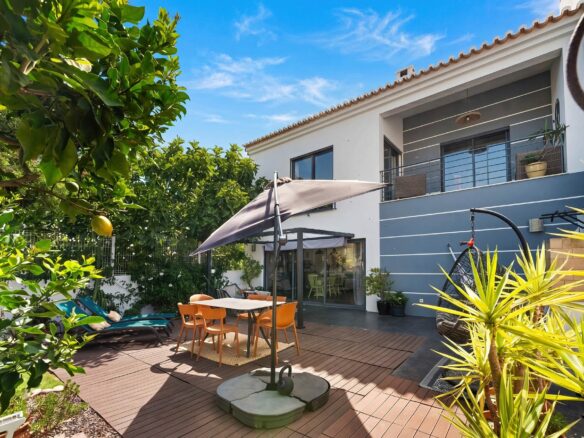
I’ve watched a deal live through that kind of gap before. A buyer of mine signed the promissory contract on a three-floor sea-view townhouse in Praia da Luz, paid a 10% deposit of just over €50,000 and asked for a six-month deed date. In those six months his crypto portfolio collapsed. We found a new buyer through my network to take over his commitment, and the owners kindly agreed not to keep the deposit. The lesson stuck with me: a lot can change between the promissory contract and the deed. This month, the thing that might change is the tax.
What do Portugal’s 2027 budget amendments mean for foreigners buying property?
Parties filed a record 2,847 amendments to the 2027 State Budget by the 6 November deadline. Most will fail. Three, all from the Socialist Party (PS), matter to the buyers I work with in Lagos, mostly British and American couples in the €500,000 to €1 million range. I’ve read the two filed texts (amendments 1840 and 2115) on the Parliament site, not just the press summaries. The third is so far only a PS proposal.
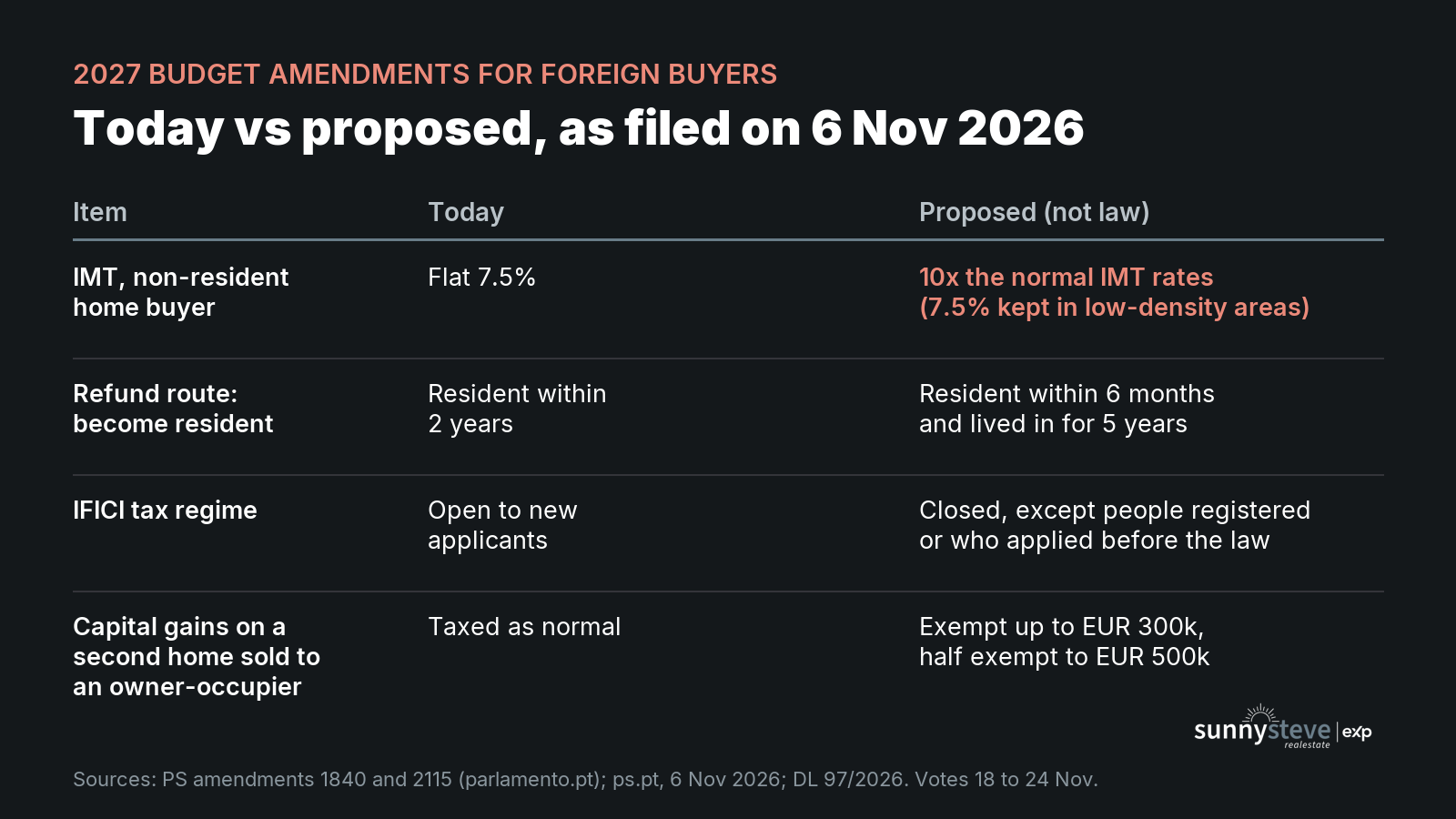
| Item | Today | Proposed | Status |
|---|---|---|---|
| IMT for a non-resident buying a home | Flat 7.5% of the price | The normal IMT rates multiplied by ten; 7.5% kept only in low-density territories | PS amendment 1840, filed, not voted |
| Cancelling the extra IMT by becoming resident | Tax resident within 2 years of the deed | Tax resident within 6 months, and the home is your permanent family home for 5 years | Part of amendment 1840 |
| Cancelling it by letting the home | Long let at up to €2,300 a month, 36 months in the first 5 years | Let under the simplified affordable-rent regime, starting within 6 months | Part of amendment 1840 |
| IFICI (“NHR 2.0”) for new residents | Open: 20% flat rate for 10 years on qualifying income | Closed to new applicants; anyone registered, or who has applied, before the law takes effect keeps it | PS amendment 2115, filed, not voted |
| Capital gains on selling a second home | Taxed under the normal rules | 100% exempt up to €300,000 and 50% from €300,000 to €500,000, when the buyer makes it their permanent home in a high-pressure area | PS proposal; no filed text read yet |
The non-resident IMT: from 7.5% to ten times the normal rates
Under Decreto-Lei 97/2026, a non-resident buying a home pays a flat 7.5% IMT at the deed, as I explained in what it costs to buy property in Portugal in 2026. PS amendment 1840 would replace that with the normal IMT rates “elevadas ao décuplo”: multiplied by ten, with no exemptions or reductions. PS’s own justification is blunt: the flat 7.5% changes nothing in the luxury segment and weighs most on mid-priced homes, so they want the rise to reach every price band.
Read literally, ten times the normal brackets would be a multiple of today’s 7.5%. That is far beyond anything Portugal has charged before, and I expect it to be fought over in committee. The text keeps the flat 7.5% in low-density territories (the list in Portaria 208/2017), so the parish matters. If you are under contract, ask your lawyer which list your parish is on. To see what today’s rules mean for your own budget, run the numbers in the SunnySteve closing-cost calculator.
The refund routes get much tighter
Today the extra IMT can be cancelled if you become a Portuguese tax resident within two years of the deed, or if you let the home long term at a moderate rent. Under amendment 1840 you would have six months to become resident, and the home would have to be your permanent family home for five years. The letting route moves to the affordable-rent regime, also for five years. Break the conditions and the tax comes back.
For a British couple planning to split the year between Lagos and home, this is the line to watch. The two-year window gave room to sell up and move. Six months does not.
IFICI would close to new applicants
Amendment 2115 revokes article 58.º-A of the tax benefits statute, which is IFICI, the regime I covered in NHR is gone: what IFICI means for buyers in 2026. People already registered, or who have applied, by the date the budget law takes effect keep it. It also orders a review of NHR, IFICI, golden visas and digital-nomad visas, including their effect on house prices, by the end of the first half of 2027.
IFICI only ever suited a narrow group (qualifying professions, no pensions), so most of my retired buyers are not affected. If you are relocating for a qualifying role and counting on it, talk to your tax adviser now about when you can apply. I won’t give a deadline date, because nobody knows yet when, or whether, the law takes effect.
Good news for some sellers: the €300,000 capital gains idea
PS also wants an exceptional three-year regime: no capital gains tax on selling a second home up to €300,000, and half the gain exempt from €300,000 to €500,000, when the buyer makes it their permanent home in an area under housing pressure. According to PS leader José Luís Carneiro, the Government was relatively open to it after their meeting on 5 November. I haven’t read a filed text for this one, and nobody has confirmed whether non-resident sellers would qualify, so don’t plan a sale around it yet.
What I’m telling buyers this week
Nothing changes today. The 7.5% stands, the two-year residency route stands and IFICI is open. What I’m doing with buyers in Lagos right now:
- If you’re close to a promissory contract, ask your lawyer how a rate change before the deed would be handled. IMT is normally paid at the deed, not at signature, unless the contract hands over the keys early.
- Keep the deed date realistic. Long gaps between contract and deed carry risk, as my Praia da Luz buyer learned.
- If you plan to become resident anyway, the six-month rule may not bother you. If you’re buying a holiday home, follow the 18 to 24 November votes closely.
I’ll update this post after the final vote on 24 November. For the bigger picture, my earlier post on what the 2027 State Budget changes for property buyers in Lagos covers the Government’s original proposal, and whether foreigners pay more for property in the Algarve shows why the politics of this are heating up.
This is a summary of filed proposals, not tax or legal advice. Speak to a Portuguese lawyer or tax adviser about your own purchase.
Frequently Asked Questions
Will Portugal raise IMT for non-resident property buyers in 2027?
Possibly. PS amendment 1840 to the 2027 budget would replace the flat 7.5% IMT for non-residents buying a home with the normal IMT rates multiplied by ten, keeping 7.5% only in low-density territories. It is a filed proposal, not law: committee votes start on 18 November 2026 and the final vote is on 24 November.
Is IFICI being abolished in Portugal?
PS amendment 2115 would close IFICI to new applicants from the date the 2027 budget law takes effect. Anyone already registered, or who has applied by then, would keep it. It is a proposal until the November votes, so speak to a tax adviser if you are counting on it.
Do I pay the new IMT if I already signed a promissory contract?
IMT is paid at the deed, not when you sign the promissory contract, so by default a buyer under contract today pays whatever rate applies on the deed date, unless the final law sets a transition rule or the contract hands over possession early. If your deed falls after a change takes effect, ask your lawyer now how the contract handles it.
Can I still cancel the 7.5% IMT by becoming a resident?
Yes, under today's rules: become a Portuguese tax resident within two years of the deed and the difference can be cancelled. Amendment 1840 would shorten that to six months and require the home to be your permanent family home for five years.
Will selling a second home under 300,000 euros be free of capital gains tax?
Not yet. PS proposes a three-year regime exempting the gain on second homes sold up to 300,000 euros, and half the gain up to 500,000 euros, when the buyer makes it their permanent home in a high-pressure area. PS says the Government is relatively open to it, but there is no law, and it is unclear whether non-resident sellers would qualify.
Buying in Lagos and wondering how this affects your timing? Tell me what you are looking for and I’ll walk you through it.