
Last updated: October 2026. Figures checked against the IRS Code and Decreto-Lei 97/2026.
A non-resident pays 25% on Portuguese long-let rental income after deductible costs, or 10% if the rent is €2,300 a month or less under the 2026 moderate-rent rule. Holiday-let income is taxed at 25% on 35% of the gross, under 9% of turnover.
That is the short version. If you are a British, Dutch or German owner of a €400k to €900k apartment or townhouse in Lagos, and you plan to let it while you still live abroad, the detail matters: which regime you fall into, what you can deduct, and who actually files the return. Here is how it works in 2026.
How much tax does a non-resident pay on rental income from a property in Portugal in 2026?
It depends on how you let the property. Portugal treats a long let and a holiday let as two different kinds of income, taxed in two different ways.
- Long let (Category F, rental income). Taxed at a flat 25% on the rent minus deductible costs. Since 1 January 2026, residential leases at a monthly rent of up to €2,300 qualify for a reduced 10% rate, until the end of 2029. Leases of five years or more already had lower rates in the Code: 15% for five to ten years, 10% for ten to twenty, 5% beyond that.
- Holiday let (Alojamento Local, Category B, business income). Under the simplified regime, 35% of the gross bookings for a house or apartment is treated as taxable profit, and a non-resident pays 25% on that slice. No further expenses are deducted.
One honest caveat on the 10%. Decreto-Lei 97/2026 created it as a new article (45.º-C) of the Tax Benefits Statute, replacing the same autonomous rate that non-residents pay on rents, and nothing in the text excludes non-residents. I have not yet seen a tax authority ruling on a non-resident landlord specifically, so have your accountant confirm it before you count on it.
Non-resident vs resident: the comparison
| Situation | Non-resident landlord | Portuguese tax resident |
|---|---|---|
| Long let, rent up to €2,300/month | 10% on rent after costs (2026 to 2029) | 10%, or opt to add it to other income |
| Long let, rent above €2,300/month | 25% on rent after costs, lower for leases of 5+ years | Same rates, or opt to add it to other income |
| Holiday let (AL), simplified regime | 25% on 35% of gross bookings | 35% of gross added to other income, taxed on the progressive scale (up to 48%) |
| Option to use the progressive scale | Only if resident in the EU or EEA. Not available to UK or US residents | Yes |
| Mortgage interest deductible? | No | No |
| Return to file | Modelo 3 with Anexo F (long let) or Anexo B (AL), 1 April to 30 June | Same |
Note the line about the progressive scale. A Dutch or German owner can choose to be taxed at Portuguese resident rates, which only helps if their total Portuguese income is low. Since Brexit a British owner cannot, and neither can an American. For most of my overseas owners that choice does not change much, but it is worth a five-minute conversation with an accountant before your first return.
What it looks like on a Lagos two-bed
Take a 90 m² two-bedroom flat in Lagos. At idealista’s September average asking price of around €4,729/m², that is roughly €425,000. To see what a specific property is worth today, use the SunnySteve property valuation.
On a long let at the Lagos average of €16.20/m² (idealista, May 2026), it rents for about €1,460 a month. Let for eleven months, that is €16,060 a year. Deduct €1,400 of condominium fees, €600 of IMI (Lagos keeps its rate at 0.3%, on an assumed tax value of €200,000) and €300 of insurance, and the taxable rent is €13,760.
| Same flat, three ways | Taxable amount | Rate | Portuguese tax |
|---|---|---|---|
| Long let at €1,460/month (moderate rent) | €13,760 | 10% | €1,376 |
| Long let, if the 10% did not apply | €13,760 | 25% | €3,440 |
| Holiday let grossing €35,000 (illustrative) | €12,250 (35% of gross) | 25% | €3,063 |
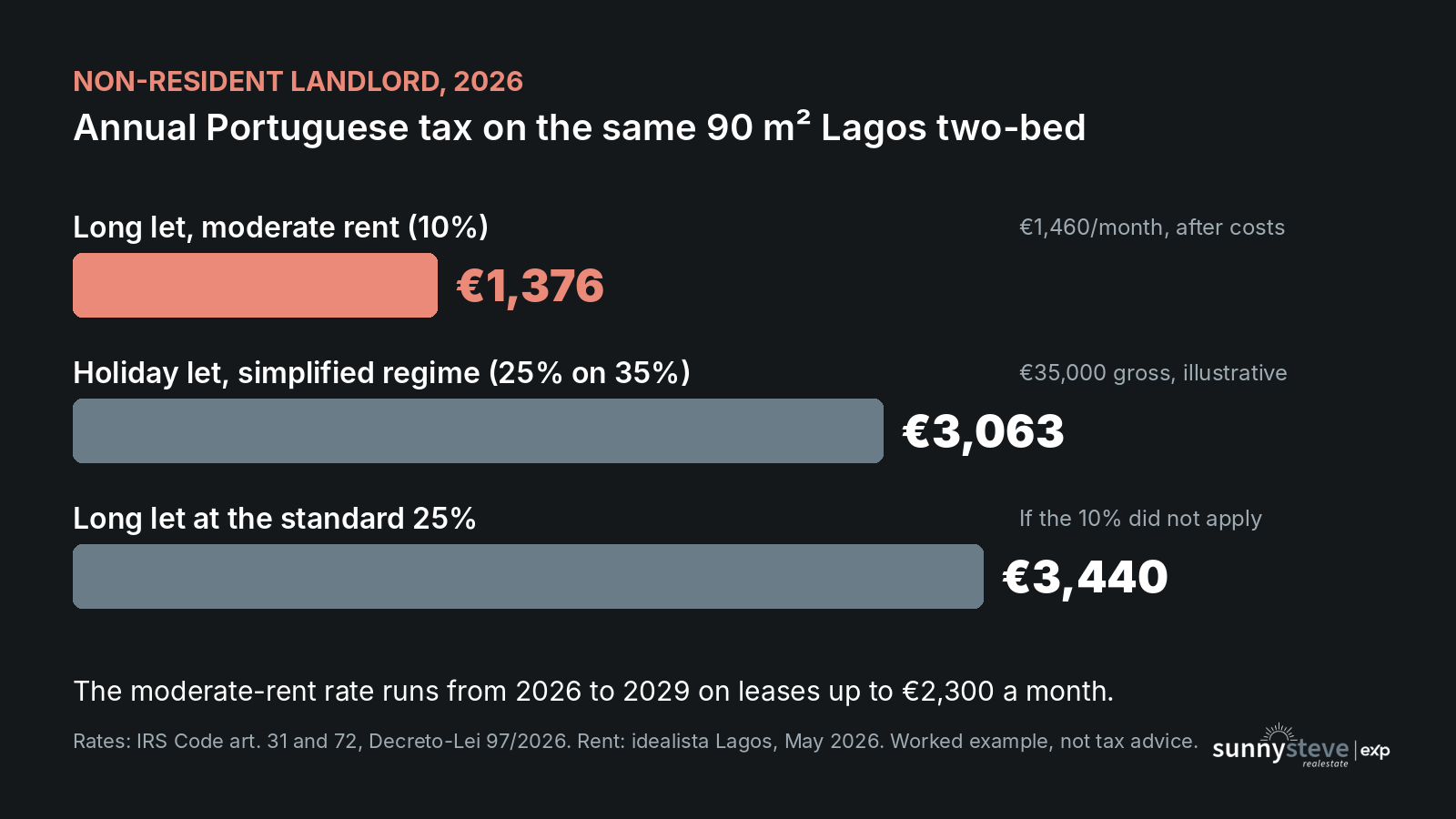
Two things stand out. The 10% rate saves this owner about €2,000 a year compared with 25%. And the holiday let pays tax on a bigger turnover, but management, cleaning and utilities eat far more of it, which is why I compared net yields properly in what rental yield you can expect from a holiday let in Lagos.
What you can and cannot deduct on a long let
On a long let you deduct the costs you actually pay to earn or keep the rent, with receipts in your name:
- IMI (municipal property tax) and condominium fees
- Maintenance and repairs, including works in the 24 months before the first lease if the property was not used in between
- Insurance on the property
What you cannot deduct: mortgage interest, furniture and appliances, and depreciation. Buyers coming from the UK are often surprised by the mortgage interest point. On a holiday let taxed under the simplified regime, you deduct nothing at all: the 65% of gross that is not taxed is your allowance for costs.
The mistake landlords make: assuming someone else files
This is the one I see most. Airbnb and Booking report your bookings to the authorities, but they do not file your Portuguese return. A letting agent collects rent, but unless you have hired them or an accountant to do it, they do not file either. A private tenant withholds nothing. So the return is yours:
- Get your NIF and register the lease (long let) or open activity and register the AL licence (holiday let).
- If you live outside the EU or EEA, appoint a fiscal representative or sign up for the electronic notification channel instead. I explain that shortcut in my guide to buying property in Lagos as a foreigner.
- File Modelo 3 between 1 April and 30 June for the previous year’s income.
- Declare the Portuguese tax at home and claim the credit or exemption your country’s tax treaty with Portugal gives you.
That last step catches people too. Under the UK, Dutch and German treaties, Portugal taxes the rental income first because the property is here. Your home country still wants it declared, and then either credits the Portuguese tax or exempts the income. It does not disappear.
If you are weighing whether to let at all, the wider rules changed this year too. I covered them in Portugal’s 2026 rental law reform for landlords, and the general picture for owners is in my Portugal property tax guide. The 2027 State Budget includes further rent measures, but it is still a proposal until the final vote on 24 November.
Frequently Asked Questions
How much tax does a non-resident pay on rental income from a property in Portugal in 2026?
On a long let, 25% of the rent after deductible costs, or 10% if the monthly rent is €2,300 or less under the moderate-rent rule that runs from 2026 to 2029. On a holiday let under the simplified regime, 25% on 35% of gross bookings, which is under 9% of turnover.
Can non-residents deduct expenses from rental income in Portugal?
Yes, on a long let. You can deduct IMI, condominium fees, maintenance and repairs, and insurance, as long as you have receipts. Mortgage interest, furniture, appliances and depreciation are not deductible.
How is Alojamento Local income taxed for non-residents?
Holiday-let income is business income (Category B). Under the simplified regime, 35% of the gross from a house or apartment is treated as taxable profit and a non-resident pays 25% on it. On €35,000 of bookings that is about €3,063, with no further expenses deducted.
Do I also pay tax at home on my Portuguese rental income?
You declare it at home, but you should not pay twice. Under Portugal’s tax treaties with countries such as the UK, the Netherlands and Germany, Portugal taxes the income first and your home country either credits the Portuguese tax or exempts the income. Check the method with your home tax adviser.
This is general information, not tax advice. Rates and rules change, so speak to a Portuguese accountant about your own situation before you let.
Thinking of buying in Lagos to let, or already own and want to know what a property could earn? Send me the address and I will give you a realistic rental-income estimate.