
Eine Variante desselben Einwands höre ich fast jede Woche von Käufern, mit denen ich in Lagos arbeite: „Wir warten, bis die Preise sinken, jetzt, da das Golden Visa weg ist.“ Das ist ein nachvollziehbarer Gedanke. Die Golden-Visa-Route über Immobilien wurde 2023 geschlossen, und die Immobilientransaktionen von Nichtansässigen gingen in ganz Portugal in den Jahren danach deutlich zurück. Wo also bleibt die Korrektur?
Neue Daten des INE, des nationalen Statistikinstituts Portugals, die diese Woche veröffentlicht wurden, beantworten diese Frage mit Zahlen statt mit einem Bauchgefühl: Die Immobilienbewertungen im Algarve erreichten im Juli 2026 3.010 Euro pro Quadratmeter, bei Wohnungen ein Plus von 16,5 % gegenüber dem Vorjahr. In den Zahlen zeigt sich keine Korrektur. Wenn überhaupt, hat der Anstieg sogar an Tempo gewonnen.
Steigen die Immobilienpreise im Algarve 2026 weiter, oder hat der Markt begonnen, sich zu korrigieren?
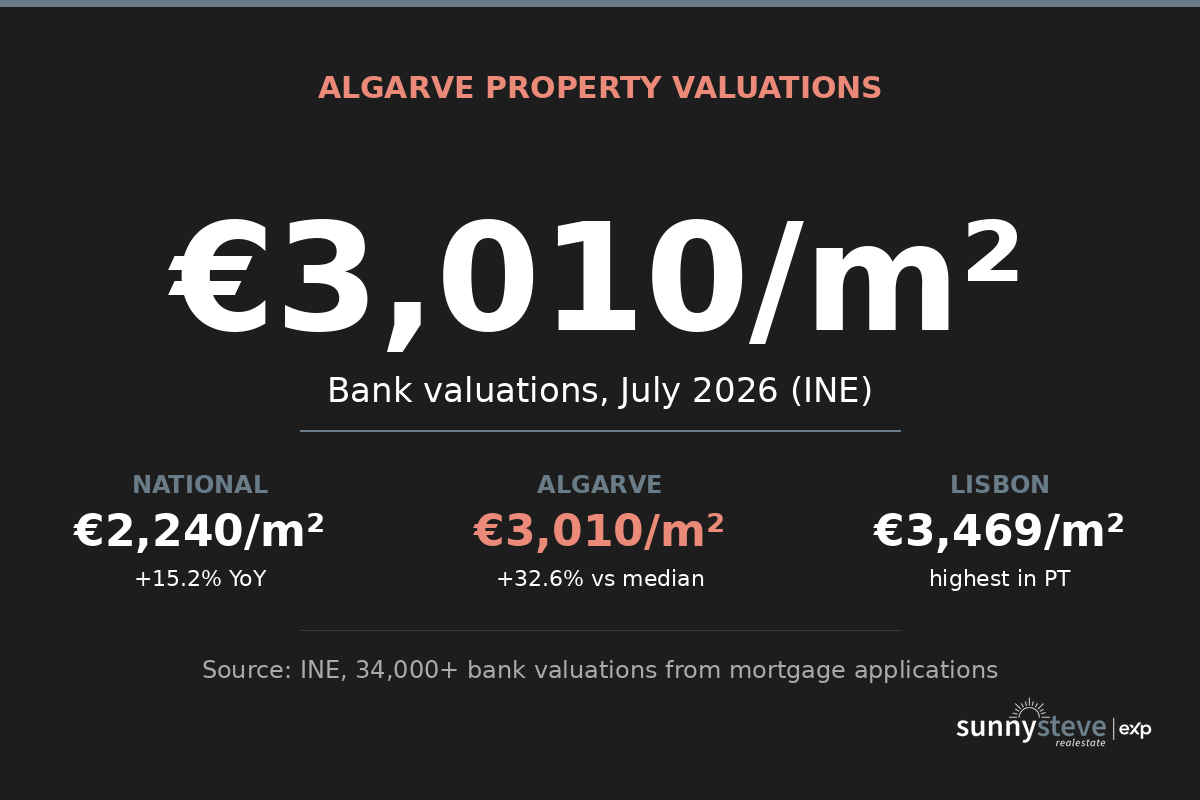
Sie steigen weiter, und zwar deutlich. Die Juli-Zahlen 2026 des INE beziffern den nationalen Median der Immobilienbewertungen auf 2.240 Euro pro Quadratmeter, bei Wohnungen landesweit auf 2.627 Euro pro Quadratmeter. Der Algarve liegt deutlich über beiden Werten: 3.010 Euro pro Quadratmeter, also 32,6 % über dem nationalen Median. Nur der Großraum Lissabon liegt mit 3.469 Euro pro Quadratmeter höher. Landesweit stiegen die Bewertungen im Jahresvergleich um 15,2 %, Häuser legten um 13,6 % zu, und Wohnungen lagen mit 16,5 % an der Spitze. Von Juni auf Juli allein kam im Monatsvergleich noch einmal ein Plus von 0,5 % hinzu.
Für alle, die tatsächlich kaufen, zählt ein Detail mehr als die Schlagzeilenzahl: Es handelt sich um Bankbewertungsdaten, nicht um Angebotspreise. Das INE erstellt sie aus mehr als 34.000 realen Bewertungen, die Banken im Zuge konkreter Hypothekenanträge durchgeführt haben. Es ist die Einschätzung des eigenen Gutachters eines Kreditgebers, was eine Immobilie heute wert ist, und nicht der Preis, zu dem ein Makler sie inseriert hat. Genau deshalb lohnt sich ein genauer Blick auf diese Daten, wenn Sie einen Kauf finanzieren: Es ist die Zahl, auf deren Grundlage Ihre Bank tatsächlich Kredit vergibt.
Warum Lagos dem Ende des Golden Visa nicht gefolgt ist
Die Logik hinter „die Preise müssten eigentlich fallen“ beruht meist auf der Annahme, Golden-Visa-Käufer hätten die Preise im Algarve gestützt, und mit dem Ende des Programms müsse die Luft entweichen. Das ist eine plausible Theorie. Sie passt nur nicht dazu, wer in Lagos überhaupt gekauft hat. Die Golden-Visa-Gruppe, historisch chinesische, amerikanische und brasilianische Investoren, konzentrierte sich überwiegend auf Lissabon, Cascais und Porto. In Lagos kaufen seit jeher andere Käufer: britische, niederländische und deutsche Lifestyle-Käufer, die hierherziehen, um wirklich hier zu leben, und nicht, um sich eine Aufenthaltsgenehmigung zu sichern. Das ist ein völlig anderes Motiv, und es blieb von den Änderungen des Jahres 2023 weitgehend unberührt.
Die INE-Zahlen dieser Woche sind die bisher klarste Bestätigung, dass Lagos nie eine Golden-Visa-Stadt war, jedenfalls nicht in dem Sinne, wie es die Schlagzeilen unterstellten. Wenn Sie mit einem Kauf in Lagos speziell deshalb warten, weil Sie auf eine Golden-Visa-Korrektur hoffen, setzen Sie auf einen Mechanismus, der hier nie wirklich gegriffen hat. Die Angebotspreisseite erzählt dieselbe Geschichte ausführlicher: Ich vergleiche Lagos mit seinen Nachbarn in Portugal has the EU’s fastest house price rise: is Lagos following?
| Region | Bewertung, Juli 2026 | Veränderung zum Vorjahr | im Vergleich zum nationalen Median |
|---|---|---|---|
| Nationaler Median | €2.240/m² | +15,2 % | Referenzwert |
| Wohnungen landesweit | €2.627/m² | +16,5 % | +17,3 % |
| Algarve | €3.010/m² | folgt dem nationalen Trend | +32,6 % |
| Großraum Lissabon | €3.469/m² | folgt dem nationalen Trend | +54,9 % |
Quelle: INE (Instituto Nacional de Estatística), Bankbewertungsdaten aus Hypothekenanträgen, Juli 2026.
Was eine steigende Bankbewertung bei einer Finanzierung tatsächlich verändert
Nichtansässige Käufer in Portugal bekommen von einem EU-Kreditgeber typischerweise 60 bis 70 % Beleihungsauslauf, bei Käufern aus Großbritannien und den USA eher 60 bis 65 %, und der Kredit richtet sich nach der eigenen Bewertung der Bank, nicht nach Ihrem vereinbarten Kaufpreis. Wenn die Bewertungen so schnell steigen, passieren meist zwei Dinge gleichzeitig, vor denen Käufer selten gewarnt werden.
Erstens wirkt ein steigender Bewertungstrend im Allgemeinen zu Ihren Gunsten: Banken bewerten eine angemessen bepreiste Immobilie seltener unter dem vereinbarten Kaufpreis, was vor zwei oder drei Jahren ein echtes Risiko war, als sich der Markt schneller bewegte als die Daten der Kreditgeber. Zweitens, und das sollten Sie unbedingt einplanen: Wenn Sie einen Preis oberhalb der Bankbewertung vereinbaren, was bei Immobilien mit starker emotionaler Anziehungskraft oder seltenem Ausblick weiterhin vorkommt, kommt die Differenz zusätzlich zu Ihrer Anzahlung aus Ihrem eigenen Geld. Bei einem Kauf für 750.000 Euro in Lagos mit 65 % Beleihungsauslauf sind das bereits 262.500 Euro Eigenmittel, noch bevor IMT, Stempelsteuer und Anwaltskosten hinzukommen. Eine Bewertungslücke von nur 5 % bedeutet weitere 37.500 Euro, die Sie in bar aufbringen müssen. Holen Sie sich eine schriftliche Bewertungsschätzung Ihres Kreditgebers ein, bevor Sie den Vertrag unterzeichnen, nicht danach.
Ich erlebe das gerade bei Kunden. Niemand zieht sich zurück, weil die Zahlen steigen. Stattdessen stellen sie schärfere Fragen zum Zeitplan der Finanzierung, denn eine Bewertung, die auch nur wenige Monate veraltet ist, kann die tatsächlich benötigte Anzahlung falsch einschätzen.
Häufig gestellte Fragen
Steigen die Immobilienpreise im Algarve 2026 weiter, oder hat der Markt begonnen, sich zu korrigieren?
Sie steigen weiter. Die INE-Daten vom Juli 2026 beziffern die Bankbewertungen im Algarve auf 3.010 Euro pro Quadratmeter, bei Wohnungen landesweit ein Plus von 16,5 % gegenüber dem Vorjahr, ohne erkennbare Verlangsamung in den Monatszahlen.
Was ist eine Bankbewertung, und wie unterscheidet sie sich vom Angebotspreis?
Eine Bankbewertung ist der Wert, den der Gutachter eines Kreditgebers einer Immobilie beimisst, wenn Sie eine Hypothek beantragen. Sie dient dazu, die Höhe des Kredits zu berechnen, und kann über oder unter dem vereinbarten Kaufpreis liegen. Angebotspreise und Maklerindizes messen etwas anderes: die Preise, zu denen Verkäufer inserieren.
Warum hat das Ende des Golden Visa die Preise in Lagos nicht abgekühlt?
Golden-Visa-Käufer konzentrierten sich auf Lissabon, Cascais und Porto, nicht auf Lagos. In Lagos kaufen seit jeher britische, niederländische und deutsche Lifestyle-Käufer, die hierherziehen, um zu leben. Diese Gruppe blieb weitgehend unberührt, als die immobiliengebundene Golden-Visa-Route 2023 geschlossen wurde.
Erschwert oder erleichtert eine steigende Bankbewertung die Hypothek im Algarve?
In der Regel erleichtert sie sie, da Kreditgeber eine angemessen bepreiste Immobilie seltener unter dem vereinbarten Kaufpreis bewerten. Das Risiko verlagert sich auf Immobilien, die über dem Marktwert gekauft werden: Dort muss die Differenz zwischen Bewertung und Preis zusätzlich zu Ihrer Anzahlung in bar gedeckt werden.
Ist jetzt ein schlechter Zeitpunkt zum Kaufen im Algarve, weil die Preise weiter steigen?
Nicht unbedingt. Auch das Warten auf eine Korrektur, die sich in den Daten nicht zeigt, hat seinen Preis, denn jedes Quartal Verzögerung hat in den letzten Jahren bedeutet, mehr statt weniger zu zahlen. Die bessere Frage ist, ob Ihr Budget und Ihre Finanzierung auf die heutigen Zahlen abgestimmt sind, nicht auf die des Vorjahres.
Sie möchten Ihre Immobiliensuche im Algarve beginnen? Sagen Sie mir, wonach Sie suchen, und ich helfe Ihnen, Ihr Budget an den heutigen Zahlen auszurichten, nicht an denen des Vorjahres.