
A client asked me this last week. He had been watching the Algarve for a while, and he put it plainly: this market has gone up for more than ten years, even in the years when parts of northern Europe were falling. How long is that going to continue?
It is the right question, and this month it got an unusually specific answer.
How long can Portugal’s house prices keep rising?
S&P Global Ratings published its updated European housing forecast in July 2026. It puts Portugal at +10% for 2026, the highest of the twelve European markets it tracks, against a European average of around 4%. Spain is second at 9.1%. S&P revised that Portugal number up by three percentage points from what it published in February.
So the short answer to my client is: it continues, but it slows.
| Year | S&P forecast, Portugal | European average |
|---|---|---|
| 2026 | +10% | around 4% |
| 2027 | +5.5% | around 3% |
| Through 2029 | around 5% a year | not stated |
That is not a market being called to a halt. It is a market being called down from double digits to something closer to normal, over about three years. BPI Research reached a similar place from a different direction, forecasting 11.7% for 2026 and describing growth as positive but moderating.
My client’s instinct was right, by the way. Portuguese house prices rose roughly 180% between 2015 and the end of 2025, one of the steepest increases anywhere in the EU according to Eurostat. Over the same stretch the euro area as a whole fell through 2023, and Finland was still down 3.1% year on year in late 2025. He has been watching a genuine outlier.
Prices are up, but sales are down
Here is the part most headlines skip, and it is the part I spend most time explaining to buyers.
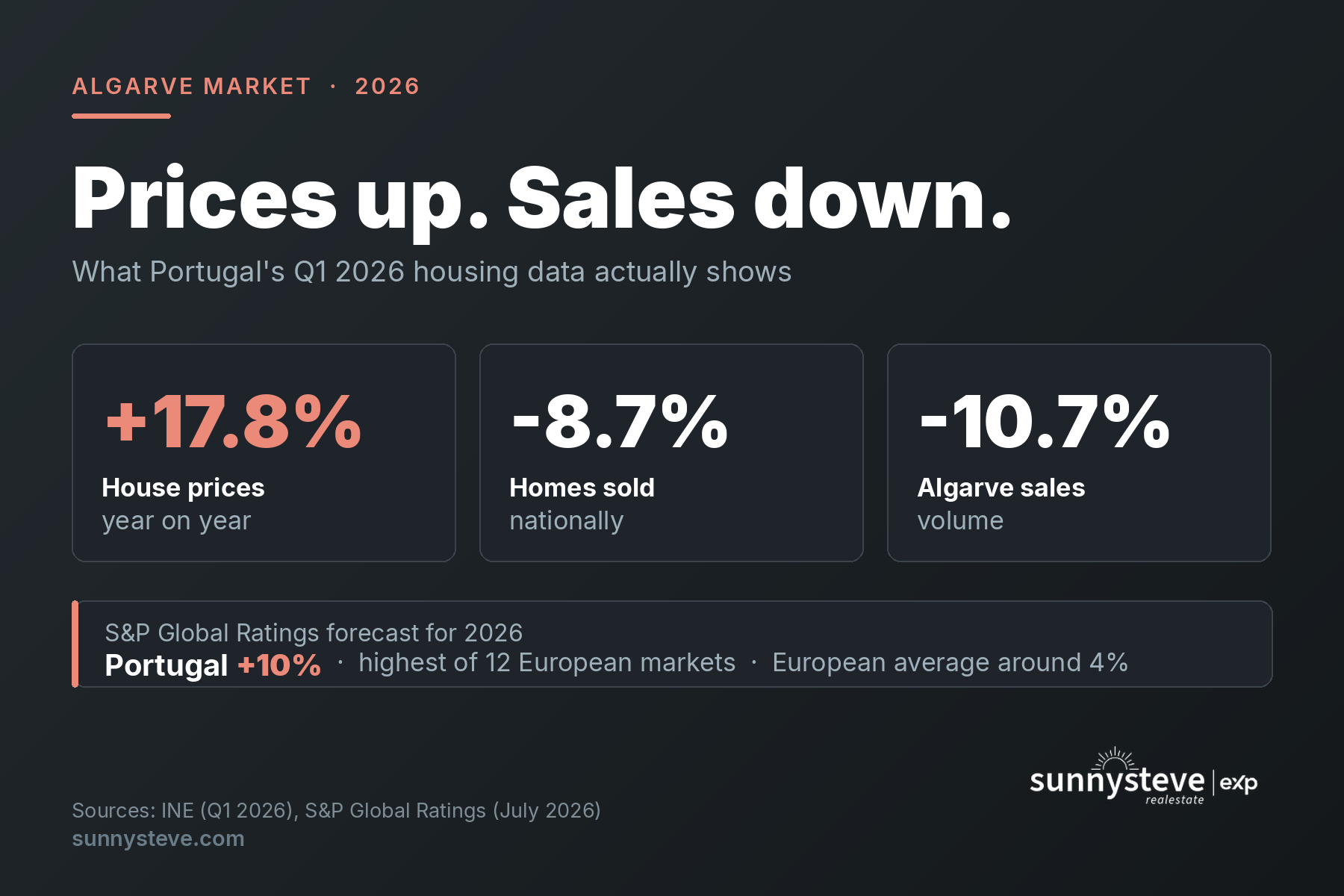
| Portugal, Q1 2026 | Figure | Change year on year |
|---|---|---|
| House price index | – | +17.8% |
| Homes sold | 37,745 | -8.7% |
| Algarve sales volume | – | -10.7% |
Prices rose 17.8% year on year in the first quarter of 2026, a slight deceleration from the previous quarter. Transactions went the other way: 37,745 homes changed hands, down 8.7% on the year and down 12.4% on the quarter, according to INE. The Algarve was worse than the national average, at -10.7%.
Rising prices on falling volume is the signature of a supply problem, not a demand mania. In a speculative run you get both numbers climbing together, because people are trading. Here, fewer people are trading and the few things that do sell are setting the price.
The supply gap behind the numbers
The Portuguese Association of Property Developers and Investors told Parliament in March that Portugal needs about 70,000 new homes a year by 2029. It is currently building roughly 20,000. The shortfall accumulated over the last decade comes to around 300,000 homes.
Worse, more than 50,000 homes were licensed in the past three years and never built, because the numbers stopped working. Every year of licensing delay adds roughly 500 euros per square metre to the cost of building, which on a modest 75 m2 apartment is 37,500 euros a year of pure waiting. That construction-cost pressure is a large part of why new builds now cost 20% to 35% more than comparable resales in the Algarve.
That is why I am cautious when someone tells me prices must fall soon. Prices fall when supply catches demand. Nothing in those figures suggests supply is about to catch anything.
What the Bank of Portugal just changed
I would be doing you no favours if I left it there, because there is a genuine counterweight and it lands next week.
From 1 August 2026, the Bank of Portugal is cutting the maximum debt service to income ratio on new mortgages from 50% to 45%. The regulator has flagged housing as a domestic risk and said the change is meant to reduce financial risk for banks and families alike. It is expected to reduce new home lending by 10 to 15%.
Read that carefully, because it cuts both ways. It is a brake on demand, and financed buyers will feel it. It is also the opposite of what a bubble looks like. In 2007 nobody was tightening anything. A regulator quietly lowering the amount families are allowed to borrow, before anything breaks, is a market with an adult in the room.
Most of my buyers are cash or substantially cash, so this changes little for them directly. If you are financing in Portugal, get your quote agreed and stress-tested at the new ratio rather than the old one.
What this means if you are buying in Lagos
Three things I would say to anyone in the 400,000 to 700,000 euro band here right now.
- Waiting for a correction is a position, not a plan. Two independent forecasters have Portugal up high single or double digits this year. If you wait twelve months to save 5%, the forecast says you pay more, not less.
- Falling volume is your friend, not your enemy. Fewer transactions means less competition on the specific house you want. It does not mean sellers have capitulated on price, and those are different things.
- Buy the property, not the index. A national 17.8% tells you nothing about whether a particular villa in Lagos is priced correctly. Half the properties I look at in the Western Algarve are still priced on what the owner hoped for in 2024. That is where the actual negotiation lives.
I wrote about the timing question in more depth in Is Now a Good Time to Buy in the Algarve, or Wait?, and I looked at the crash argument itself in Is the Algarve Real Estate Bubble About to Burst?. The numbers above are the 2026 update to both.
So, to answer my client properly: the run continues through 2026, decelerates through 2027, and settles near 5% a year after that. Nobody credible is forecasting a fall. What they are forecasting is that the easy years are behind us, which is a very different thing from a warning.
Frequently Asked Questions
Is the Portuguese property market in a bubble in 2026?
The data does not support that description. A bubble is credit-driven and shows rising prices alongside rising transactions. Portugal has the opposite: prices up 17.8% year on year in Q1 2026 while sales fell 8.7%, on a structural shortfall of around 300,000 homes. The Bank of Portugal is also tightening lending rules rather than loosening them.
Will house prices in Portugal fall in 2027?
Not according to the current forecasts. S&P Global Ratings expects Portuguese prices to rise 5.5% in 2027, against a European average of about 3%, then around 5% a year through 2029. That is deceleration, not decline.
Why are Algarve property sales falling if prices are rising?
Algarve transaction volume fell 10.7% year on year in Q1 2026, worse than the national 8.7% drop. The causes are affordability at current price levels and a shortage of stock worth buying, not a collapse in interest. Fewer buyers are competing, but the properties that do sell are still setting higher prices.
Does the new Bank of Portugal lending rule affect foreign buyers?
It affects anyone taking a Portuguese mortgage. From 1 August 2026 the maximum debt service to income ratio drops from 50% to 45%, which is expected to cut new lending by 10 to 15%. Cash buyers are unaffected. If you are financing, price your purchase on the 45% rule.
Is it better to wait for prices to drop before buying in Lagos?
On the current forecasts, waiting costs money rather than saving it. What I tell buyers is to stop trying to time the national index and start negotiating hard on the individual property, because plenty of Western Algarve listings are still priced on 2024 expectations.
Ready to start your Algarve property search? Tell me what you are looking for and I will come back to you with what is actually available in your band.