

Decreto-Lei n.º 97/2026 was published in Diário da República on 20 May 2026. Among a long list of housing measures, it put a flat 7.5% IMT on residential property bought by anyone who is not a Portuguese tax resident, with no progressive scale and no exemptions.
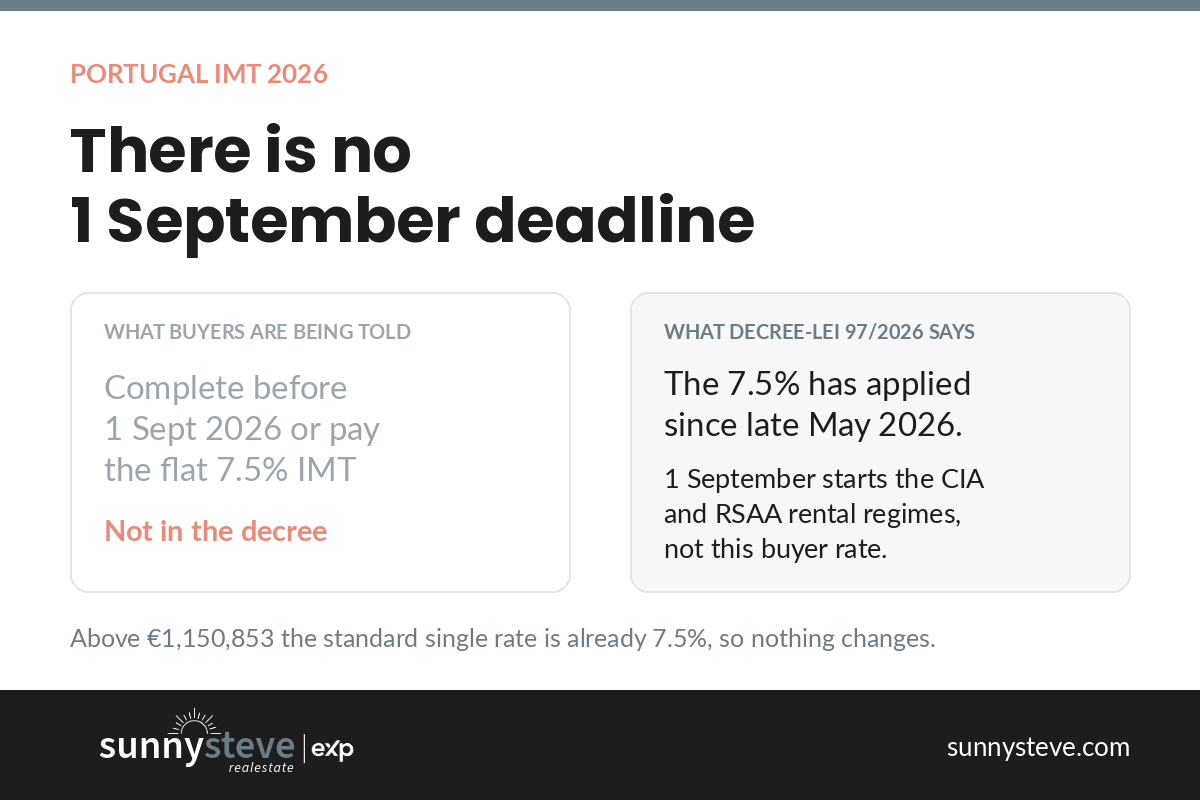
Since then a deadline has been circulating around the Algarve: complete before 1 September 2026 and you still pay the old progressive rates. I have seen it on agency websites, in buyer newsletters and in a relocation group this month. It is wrong. September belongs to two other parts of the same law.
Do I have to buy in Portugal before 1 September 2026 to avoid the 7.5% IMT?
No. There is no 1 September cut-off for the non-resident IMT rate. The article that creates it carries no transitional provision, which is why the professional reading is that it has applied since the decree took effect in late May 2026.
PwC Portugal’s summary of the decree lists the non-resident IMT rate with no future start date, while flagging explicitly that two other regimes in the same law produce effects from 1 September. Andersen’s note on the decree says the same thing in different words: most provisions take effect from 1 January 2026, the VAT changes from 1 July 2026, and only the two new rental regimes wait for September.
When I wrote about this rate in June I said the start date was genuinely disputed and told people not to plan around a September deadline. Three months on, the firms that read these decrees for a living have converged, and none of them puts this rate in September.
One honest caveat. The tax authority has not, to my knowledge, published a formal clarification settling it in writing. So this is a strong professional consensus rather than a ruling. Have your lawyer confirm the position before you sign anything, which you should be doing anyway.
What 1 September 2026 actually changes
Two new regimes start that day, and neither of them is about buyers:
- Contratos de Investimento para Arrendamento (CIA). Agreements between investors and the IHRU, up to 25 years, for projects putting at least 70% of built area into residential letting at rents up to €2,300 a month. They carry IMT, stamp duty, IMI and AIMI exemptions.
- Regime Simplificado de Arrendamento Acessível (RSAA). The replacement for the old affordable rental programme, with full IRS and IRC exemption on qualifying rental income.
Both are aimed at developers and landlords supplying long-term rental stock. If you are a Dutch couple buying a two-bed in Lagos to live in, neither applies to you, and neither is a reason to rush a purchase.
What the 7.5% actually costs a non-resident buyer
Here is the real arithmetic, comparing the flat 7.5% against the 2026 progressive scale for a home that is not your permanent residence. Bracket values are PwC’s Guia Fiscal 2026.
| Purchase price | IMT on the progressive scale | Flat 7.5% for non-residents | Extra you pay |
|---|---|---|---|
| €250,000 | €8,106 | €18,750 | €10,644 |
| €350,000 | €15,300 | €26,250 | €10,950 |
| €500,000 | €27,300 | €37,500 | €10,200 |
| €750,000 | €45,000 | €56,250 | €11,250 |
| €1,000,000 | €60,000 | €75,000 | €15,000 |
| €1,200,000 | €90,000 | €90,000 | €0 |
Two things in that table are worth more than the headline. First, the extra cost sits in a fairly narrow band of roughly €10,000 to €15,000 across most of the Western Algarve market, because above €330,539 the standard marginal rate is already 8%, which is higher than 7.5%.
Second, and almost nobody mentions this: above €1,150,853 the change costs a non-resident nothing at all. The standard single rate at that level is already 7.5%. If you are buying a villa on the Lagos or Praia da Luz coast above roughly €1.15m, your IMT bill is identical either way.
See the impact on your purchase: the free Portugal mortgage calculator calculates your maximum price, deposit and the 7.5% IMT, and shows what you would pay as a resident instead.
The two ways to get the difference back
The 7.5% behaves less like a tax and more like a refundable deposit, provided you meet one of two conditions. On application, the tax authority can cancel the difference between what you paid and what the normal rates would have produced.
- Become a Portuguese tax resident within two years of the purchase. The clock runs from the escritura, not the promissory contract. For anyone moving over on a D7 or D8 this is the obvious route, and it makes the whole change a wash.
- Let the property long term at a moderate rent. Rent of €2,300 a month or less, the contract signed within six months of purchase, and the property let for at least 36 months across the first five years.
Both need planning before you sign, not after. The residency timeline in particular is something to map out at offer stage, because two years goes quickly when a move involves selling a house somewhere else.
What this means if you are buying now
Do not compress a purchase to hit a date that does not exist. A rushed escritura means rushed due diligence, and in this region that is where the real money is lost: unlicensed extensions, a caderneta that does not match what is built, a rustic plot someone has described as building land. Those cost far more than €10,000 to unpick.
If you are buying to live here, budget the 7.5% as cash you will get back, and plan the residency timeline properly. If you are buying a holiday home you will not let out and will not move into, it is a real cost, and it belongs in your offer arithmetic rather than your completion date. It is also worth knowing what else the same decree gives you, including the 6% VAT rate on qualifying construction work, which can be worth considerably more than the IMT costs you.
And if anyone tells you the window shuts on 31 August, ask them which article of the decree they are reading.
Frequently Asked Questions
When did Portugal’s 7.5% IMT for non-residents actually start?
Decreto-Lei n.º 97/2026 was published on 20 May 2026 and the non-resident IMT article carries no transitional provision, so the professional reading is that it has applied since the decree took effect in late May 2026. The 1 September 2026 date attached to this package belongs to the two new rental regimes, the CIA and the RSAA, not to the buyer rate.
Does the 7.5% IMT apply to land or commercial property?
No. It applies only to urban residential property, meaning a house, apartment or autonomous fraction used exclusively as housing. Building plots, commercial units and rustic land are unaffected and keep their normal IMT treatment, which is 6.5% for most urban non-residential property and 5% for rustic. That matters in the Western Algarve, where a lot of buyers are purchasing plots to build on.
Is the 7.5% charged on top of the normal IMT?
No, it replaces it. You pay 7.5% of the purchase price instead of the progressive scale, not in addition to it. On a €500,000 home that is €37,500 rather than €27,300, so the extra cost is €10,200. Stamp duty at 0.8%, notary and legal fees are unchanged and sit on top of either figure.
Does the 7.5% IMT apply to EU citizens buying in Portugal?
Yes, if you are not a Portuguese tax resident at the time of purchase. The test is tax residence, not nationality or EU membership. A Dutch or Irish buyer who has not registered as resident in Portugal is treated the same as an American or British one, and the same two refund routes are open to all of them.
How do I claim the difference back if I become resident?
You apply to the tax authority, which can then cancel the difference between the 7.5% you paid and what the normal rates would have produced. You need to have become a Portuguese tax resident within two years of the acquisition date, counted from the escritura rather than the promissory contract. Map that timeline with your accountant before you sign, because the two years passes quickly during an international move.
Ready to work out what your own purchase would actually cost under the current rules? Tell me what you are looking for and I will map the numbers and the timing against your situation.