

On 9 September the European Commission proposed the Affordable Housing Act, and within hours the headlines had it banning Airbnb. It does not. The proposal sets out the evidence a city has to produce before it restricts short-term lets or second homes, and it changes nothing for anyone who owns or is buying property in the Algarve today.
Is the EU going to ban Airbnb and short-term rentals in Portugal?
No. The Commission’s own question-and-answer document puts it in one line: “The Regulation does not ban or restrict Short-Term Rentals.” On second homes it is just as direct, stating that the Act “does not introduce any EU restriction on the purchase or use of second homes (or indeed on STRs)”, and does not hand local authorities any new power to impose one.
What the proposal actually does is set common conditions that a national, regional or municipal authority has to satisfy if it decides to restrict short-term lets or non-primary-residence property. Housing policy stays exactly where it was. The Commission is blunt about that too: “Ultimately, decisions about housing policy will remain with national, regional and local authorities.”
What the Commission proposed on 9 September 2026
The document is COM(2026) 599 final, filed as 2026/0268 (COD), with Article 114 TFEU as its legal basis. It is a proposed Regulation, not a law. It now goes to the European Parliament and the Council under the ordinary legislative procedure, where it can be amended, delayed or dropped. Alongside it the Commission published a separate Recommendation, which is not binding on anyone.
Here is the gap between the coverage and the text.
| What you will read this week | What COM(2026) 599 says |
|---|---|
| The EU is banning Airbnb | “The Regulation does not ban or restrict Short-Term Rentals” |
| Brussels will restrict second homes | No EU restriction on buying or using a second home, and no new power for authorities to create one |
| It is now law | A proposal, at the start of the ordinary legislative procedure |
| Councils can act as they like | They must first prove housing stress, then prove necessity and proportionality |
| Existing owners are exposed | Acquisition measures cannot be retroactive, and bind only property bought after the measure’s date |
The second-home limb almost nobody is reporting
This is the part that matters most to my clients, and it is buried under the Airbnb headlines. The proposal has two limbs, not one. The first covers measures restricting short-term rental accommodation services. The second covers measures restricting the acquisition or use of residential property “not used as primary residence”. The Commission’s press release gives the example plainly: second homes and prolonged vacancy.
If you are buying a holiday home in Lagos or Praia da Luz, that second limb is the one that concerns you, and it comes with a safeguard worth knowing. Any measure on acquisition applies only to property bought after that measure takes effect. It cannot reach back and catch a home you already own. For short-term lets, measures have to target activity of commercial scale rather than an owner letting one apartment.
Several things sit outside the scope entirely: general property ownership and transfer rules, inheritance, gifts and intra-family transfers, rent regulation, housing benefits, building standards, general zoning, and taxation. That last one matters more than it looks. Tax is explicitly out of scope, so this proposal is not a back door to a foreign-buyer levy or a change to IMT, whatever you may see suggested.
How a council would have to prove its case
Before restricting anything, an authority has to designate the area as being under “housing stress”. The Commission sets a sequence for that.
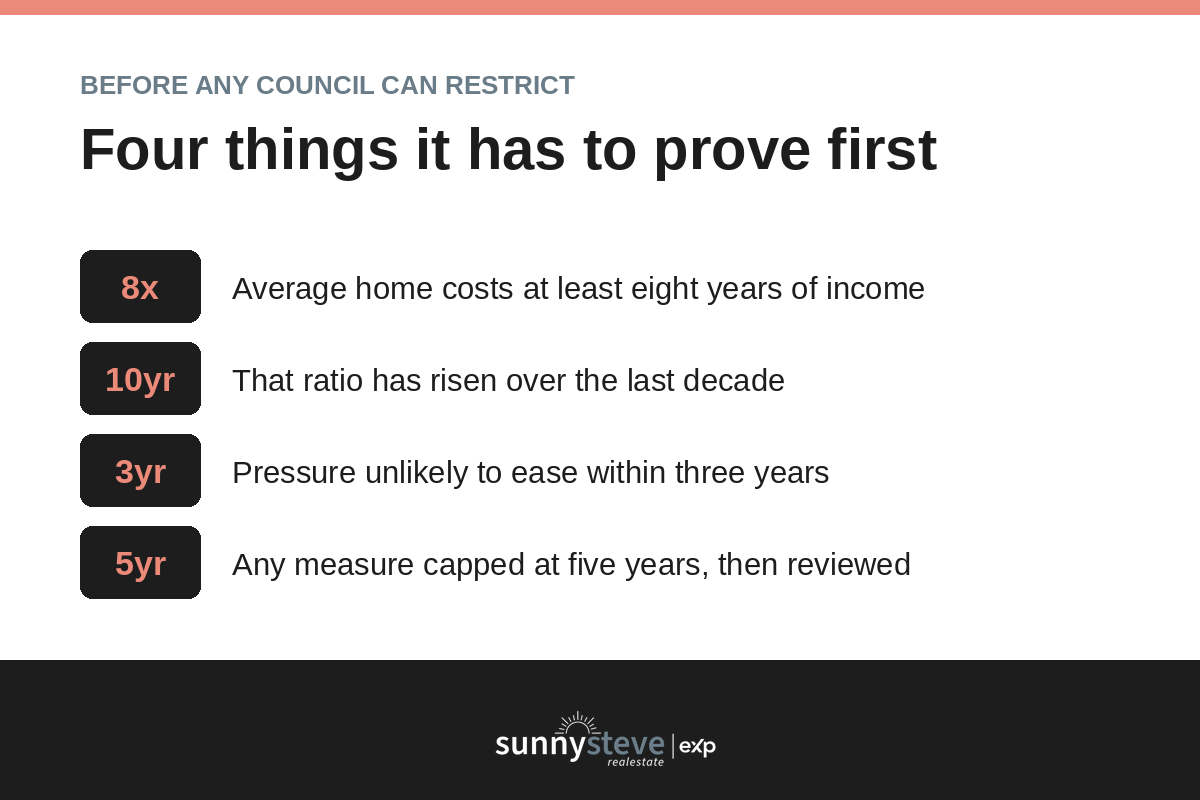
- A pre-screening on the price-to-income ratio: the average dwelling must cost at least eight years of per capita disposable income.
- That ratio must also have risen over the most recent ten years, unless it already sits at ten or above, in which case the growth test falls away.
- A detailed look at local housing supply and demand, plus demographic and population trends.
- A finding that the stress is unlikely to ease over the next three years.
- Data that is objective, transparent and verifiable.
If it clears that bar and still wants to act, it then has to show a significant adverse effect on affordability or availability lasting at least three years, show that less restrictive alternatives would not work as well, target the measure to the stressed area, respect the right to property under Article 17 of the Charter, cap the measure at five years, and review it regularly.
Whether Lagos or Portimao would clear that price-to-income threshold is an open question. I have not seen anyone publish the local figure, and I would want to see it before accepting anyone’s claim in either direction. For scale, the Commission’s own worked example is central Madrid, where there are roughly 40 short-term rentals for every 100 homes in the long-term rental market. The Western Algarve is not Madrid.
What it means if you own an AL in Lagos, Vila do Bispo or Aljezur
This week, nothing. I watch the Alojamento Local register across those three councils, and this proposal does not change a single registration, licence or obligation on it. Anyone telling you to sell before the EU shuts you down is reading headlines rather than the text.
What is worth your attention is the rule that already applies, covered below. If you are weighing whether an AL licence is still worth having at all, I went through the current Lagos position in Can You Still Get an AL Licence in Lagos?, and none of it is overturned by what happened on 9 September.
What it means if you are buying in the 300k to 500k band
That is the band an AL-viable apartment in Lagos usually sits in, and it is where most of the buy-to-let questions I get come from. Two points carry over directly. Non-retroactivity means a purchase you complete now cannot be caught by a future acquisition measure. Commercial-scale targeting means one apartment let out for part of the year is not the profile this framework is aimed at.
The arithmetic of whether short-letting actually pays is a separate question, and one I would think about harder than this proposal. I ran the real numbers on that in Can Airbnb Pay Off Your Algarve Retirement Home?
The rule that already changed, and most people missed
While everyone argues about a proposal, a binding EU regulation has been in force since May 2026. Regulation (EU) 2024/1028, adopted on 11 April 2024, governs data collection and sharing for short-term rental accommodation services. It is the one that brings registration numbers and platform data sharing into a common European framework, so authorities can finally see what is actually being let.
The Affordable Housing Act builds on it deliberately. Authorities would be required to take account of data obtained under 2024/1028, and to apply and enforce it, registration requirements included. So the practical sequence is not “EU bans Airbnb”. It is: the data arrives first, and only then can anyone argue about restrictions from evidence.
One last point of confusion worth clearing up. This is short-term rental territory, and it is a different regime from the long-term rental reform that went through earlier this year, which I covered in Portugal’s New Rental Rules. If someone is quoting one at you to make a point about the other, they have the wrong law.
Where this actually lands
A proposal at the start of the ordinary legislative procedure is a long way from anything you need to act on. The Parliament raised objections on day one. Even in the version adopted by the Commission, the design is a set of brakes on local authorities, not a set of powers handed to Brussels. If it eventually passes, the practical effect in the Western Algarve is that any council wanting to restrict would have to publish real numbers and defend them, which is more accountability than exists today, not less.
Frequently Asked Questions
Do I need to do anything about my Alojamento Local licence right now?
No. The Affordable Housing Act proposed on 9 September 2026 is a legislative proposal, not a law, and it changes no AL registration or obligation in Lagos, Vila do Bispo or Aljezur. The rule that does already apply is Regulation (EU) 2024/1028 on short-term rental data and registration, in force since May 2026. If your registration is in order under that, there is nothing new to do this week.
Could Lagos restrict short-term rentals under these new EU rules?
Only if it first designates itself an area under housing stress, which means showing that an average home costs at least eight years of per capita disposable income, that the ratio has risen over ten years, and that the pressure is unlikely to ease within three years. It would then have to prove any restriction is necessary, proportionate and targeted, and cap it at five years. I have not seen anyone publish the Lagos price-to-income figure, so nobody can honestly claim the town clears that bar yet.
Does this affect buying a second home in the Algarve?
Not today. The Commission states that the Act introduces no EU restriction on the purchase or use of second homes and gives authorities no new power to create one. The proposal does cover measures on property not used as a primary residence, but any such measure would apply only to property bought after it takes effect, so it cannot reach a home you already own.
Is this the same as Portugal’s rental law reform from earlier in 2026?
No, and the two get confused constantly. Portugal’s 2026 reform changed the long-term tenancy regime for landlords letting under residential contracts. This EU proposal is about short-term holiday letting and non-primary-residence property. They are separate regimes with separate rules, so an argument about one tells you nothing about the other.
Will a foreign-buyer tax come in through this proposal?
It cannot. Taxation is explicitly outside the scope of the Affordable Housing Act, along with general property ownership and transfer rules, inheritance, gifts, rent regulation, building standards and zoning. Any change to IMT or a levy on non-resident buyers would have to come from Portugal’s own tax legislation, not from this text.
Ready to start your Algarve property search? Tell me what you are looking for and I will tell you honestly what the rules do and do not affect.