

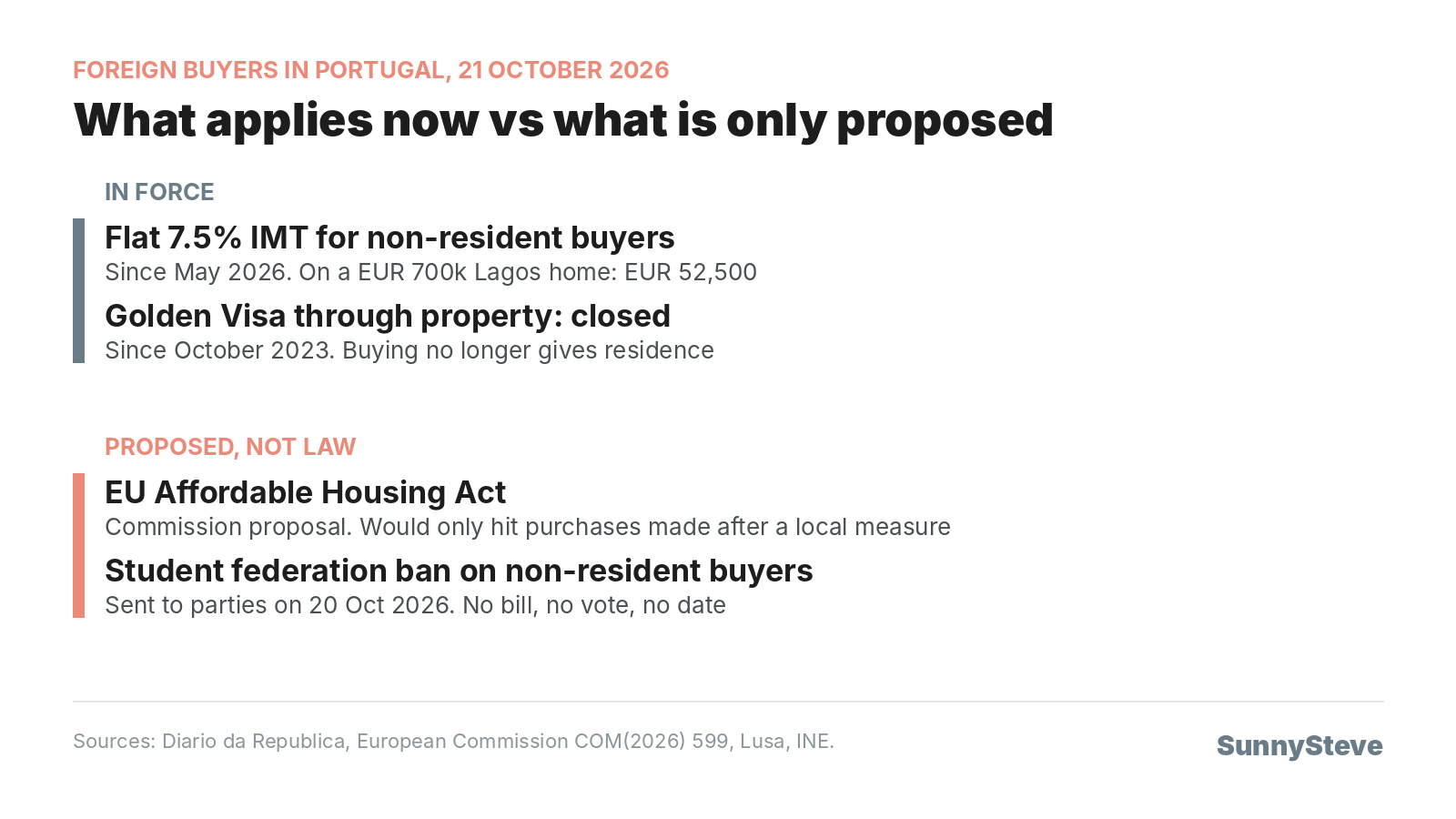
No. As of 21 October 2026 there is no law, bill or government plan in Portugal to ban or restrict foreign property buyers. The only ban on the table is a student federation’s proposal sent to parliament on 20 October. What already applies to non-residents is a flat 7.5% IMT.
The headlines from Lisbon and Porto travel fast, and the question that follows is always the same. If you are a British or American buyer looking at a second home in Lagos somewhere between €500k and €900k, here is what actually happened, what is real, and what I would do about it.
What happened in Portugal’s housing protests in October 2026
It was a tense week. Police cleared a housing activists’ tent camp in Porto in a pre-dawn operation on Monday 12 October, and a housing protest on 15 October drew thousands after clashes with police. On Saturday 17 October, Portugal’s biggest union, CGTP, filled one of Lisbon’s main avenues with what it called “many tens of thousands” of people protesting about housing and living costs.
The anger is real and the numbers behind it are not in dispute. According to Reuters, house prices in Portugal have more than doubled since 2017, rents on new leases have nearly doubled, and inflation was 3.6% in September. Wages have not kept up.
Here is the part that matters for you: the reporting on the marches does not list a foreign-buyer ban among the demands, and the government’s response has gone the other way. The Parliamentary Affairs Minister, Carlos Abreu Amorim, said the government “will not yield to shouts from the street”. Prime Minister Luís Montenegro defended a supply-side record: a target of 59,000 homes built or renovated under the recovery plan, faster planning rules, an IMT and stamp duty exemption for first-time buyers up to 35, and a state mortgage guarantee for young buyers. Not one of those measures targets foreigners.
Will Portugal restrict foreign property buyers after the 2026 housing protests?
Not in any form that exists today. The only concrete ban proposal came on 20 October from the Porto Academic Federation of Students (FAP). It sent parliament’s parties a package that includes a temporary ban on non-residents buying homes, mainly in the municipalities under most pressure. It points to Canada and to rules in Austria, Malta, Slovenia, Greece and Poland as precedents.
Read that carefully. It is a proposal from a student body, not a bill, and no party has adopted it. The same package also asks for income tax relief for landlords on permanent rentals, a mortgage interest deduction, and a national scheme for modular construction. The federation itself argues that rent caps reduce supply. It is a broad wish list, and the ban is one line in it.
Here is what is real, side by side:
| Measure | Status on 21 Oct 2026 | What it means for a non-resident buying in Lagos |
|---|---|---|
| Flat 7.5% IMT for non-residents | In force since May 2026 | Applies to you now. On a €700k second home that is €52,500 in IMT |
| Golden Visa through property | Closed since October 2023 | Buying a home no longer gives you a residence route |
| EU Affordable Housing Act | Commission proposal, not law | Could let councils in “areas under housing stress” limit second-home purchases, only for property bought after a measure takes effect |
| FAP non-resident purchase ban | Student proposal sent to parties on 20 Oct | No bill, no vote, no date. Nothing changes for you today |
| Government housing package | Being rolled out | Supply-side and aimed at young residents. No foreign-buyer measures |
Why a nationwide ban is harder than the headlines suggest
First, the data does not support the story that foreigners are driving the national market. INE figures for 2025 show buyers with a tax address outside Portugal bought 8,471 homes, just 5% of the 169,812 sold nationally. That number has now fallen for three years in a row, down 13.3% on 2024.
The Algarve is different, and I will not pretend otherwise. Non-resident buyers bought 20.1% of the homes sold here in 2025 and 31.3% of the value. That is exactly why a regional limit is more plausible than a national one, and why the EU proposal, which works area by area, is the one I am actually watching.
Second, the law. Any Portuguese rule that singled out buyers by where they live runs straight into EU rules on the free movement of capital. That is why the European examples the students cite mostly work through permits, residency tests or regional exceptions rather than a blanket ban. Canada could simply legislate its ban in 2023 and extend it into 2027. Portugal cannot do that on its own. Spain is the closest comparison: its government floated a 100% tax on non-EU buyers in 2025, and as of early 2026 it had not been approved.
Third, the EU proposal protects people who have already bought. As I covered in my breakdown of the EU Affordable Housing Act, any acquisition limit would only apply to property bought after the measure takes effect. And it is still a proposal working its way through Brussels.
What I would do if you are buying a second home in Lagos
My honest read: the protests raise the political temperature, but they have not produced a single rule that changes what a British or American buyer can do in Lagos this year. The tax side has already moved, and that is where your money goes.
- Budget the 7.5% IMT, not a ban. The flat non-resident rate is the change that is costing buyers real money right now. My breakdown of the 2027 State Budget shows it saves non-residents €0. Run your numbers in the closing cost calculator.
- Do not rush to beat a deadline that does not exist. Anyone telling you to sign this month “before the ban” is selling urgency, not facts.
- Think about residency timing. If you plan to move to Lagos rather than visit, when you become resident affects the tax you pay on purchase. Get that answered by a lawyer before the CPCV.
- Buy on the long view. The real political risk in the Algarve sits with short-term rental licensing, not ownership. Price the property as a home first and a rental second.
If you want the whole process laid out, from NIF to notary, start with my guide to buying property in Lagos as a foreigner. If you already own here and wonder what the noise means for your home’s value, see what it is worth today with the SunnySteve estimate.
This is a market view, not legal advice. Rules can change quickly in a heated political year, so confirm your own position with a Portuguese lawyer before you commit.
Frequently Asked Questions
Is Portugal banning foreigners from buying property in 2026?
No. There is no law, bill or government plan to ban foreign buyers in Portugal as of October 2026. The only ban idea is a proposal sent to parliament’s parties by the Porto Academic Federation of Students on 20 October, which no party has adopted.
Can Americans and British people still buy property in Portugal?
Yes. Americans and Britons can buy freehold property in Portugal with a NIF tax number, on the same legal footing as Portuguese buyers. The main difference since May 2026 is tax: non-residents pay a flat 7.5% IMT on residential purchases.
Would a ban on foreign buyers affect people who already own a home in the Algarve?
Nothing on the table today would. The EU Affordable Housing Act proposal only allows limits on property bought after a local measure takes effect, so existing owners are protected. The student proposal does not mention existing owners at all, and it is not a bill.
Should I buy in Lagos now before the rules change?
Buy when the property and the numbers are right, not to beat a deadline. No restriction on foreign buyers has a date attached. The cost that has actually changed is the 7.5% non-resident IMT, so build that into your budget from the first viewing.
Looking at Lagos or the Western Algarve and want a straight answer on what applies to you? Tell me what you are looking for and I will come back to you personally.