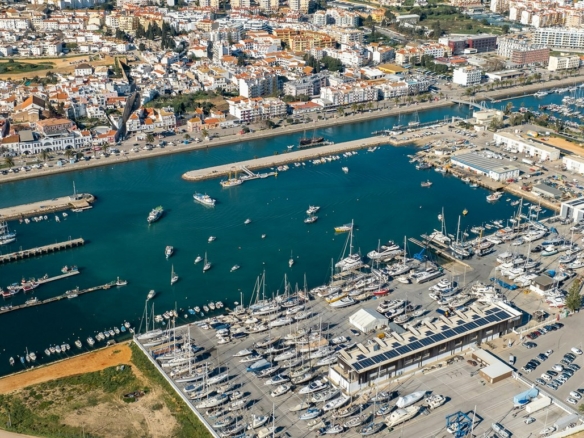

A client asked me this last week: “Why are villas in Lagos freezing in February when it’s 18 degrees outside?”
Good question. And the honest answer is the same reason a lot of Algarve homes are boiling in August and miserable in January: they are built of concrete, with almost no insulation. Which, until very recently, was how every villa in the Western Algarve got built.
That is changing now. For the first time, there is a genuinely sustainable development being built here at scale — homes that are passive-house specification, store more carbon than they emit, sit inside a 1.5-hectare working landscape with orchards, a food forest, and a natural swimming pond, and go up 40% faster than a traditional concrete build. If you are buying in the Western Algarve in 2026, especially coming from the Netherlands, Germany, or Scandinavia, this shift is the most important thing to understand before you sign anything.
The Algarve’s Concrete Problem
For decades, Portuguese builders in the Algarve have worked almost exclusively in concrete. There are real reasons for that. Concrete is cheap. It is fast. The trades are skilled — Portugal has world-class concrete crews, and they can put up a villa shell in weeks. In a warm climate with cheap materials and abundant skilled labour, it made commercial sense for a long time.
The problem is thermal performance. Traditional Algarve villas are essentially uninsulated concrete boxes. In summer, the walls soak up heat all day and release it into the bedrooms all night. In winter — and we do get winter here, with nighttime temperatures into single digits — the same walls pull warmth out of the house faster than any reasonable heating system can replace it.
The result is what my client’s friend experienced: a beautiful villa that hits 14 degrees indoors in February and 30 degrees indoors in August, with electricity bills that climb every year as you try to fix it with air conditioning and oil-filled radiators.
Why This Matters More in 2026
Three things have shifted. Energy costs turned the winter bill into a real monthly line item, and retrofitting an uninsulated concrete villa typically runs €50,000 to €120,000 — no rounding error. The buyer profile changed too: a large share of my clients are relocating full-time, not buying a summer home, so they need a year-round house. And most importantly, buyers from Northern Europe already know what good feels like. If you have lived in a properly insulated Dutch or German home, walking into an Algarve concrete villa in February is a shock. You notice it in five seconds. And once you have noticed, you cannot un-notice it.
Enter BMS: The First Eco-Sustainable Development in the Algarve
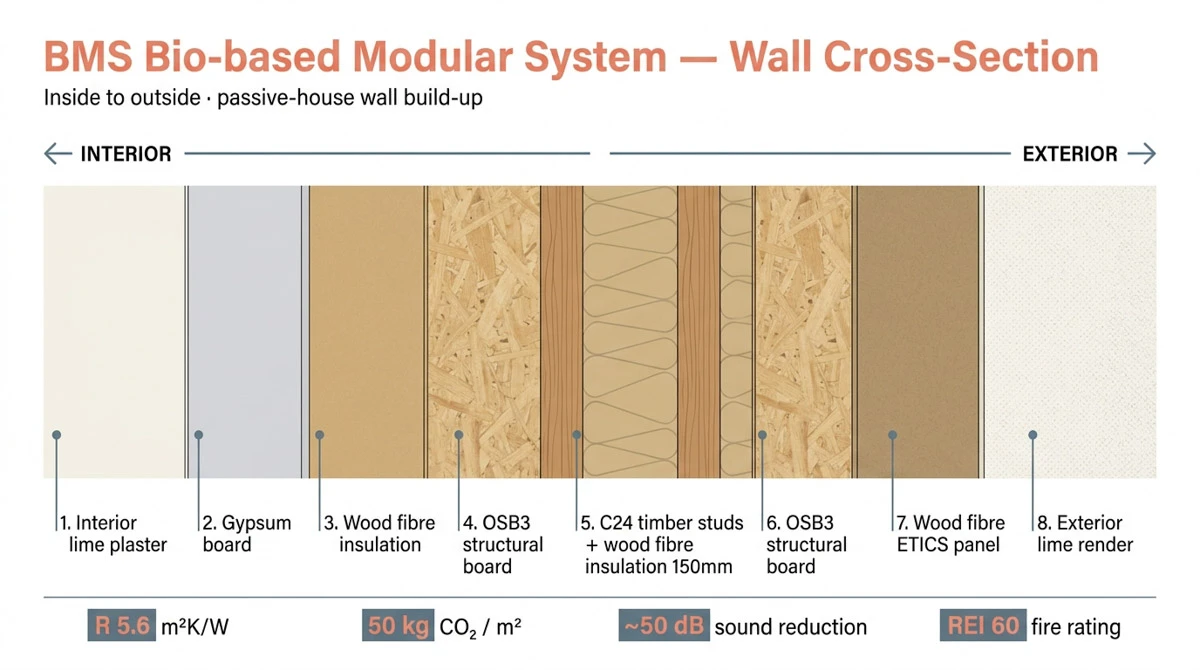
The construction system is called BMS — Bio-based Modular System. Panels arrive pre-fabricated, walls go up in days rather than months, and the numbers are unlike anything concrete can deliver:
- Thermal performance of R 5.6 m²K/W — interior temperatures stay in a narrow band year-round with minimal heating or cooling
- Around 50 kg of CO2 stored per square metre of wall — the house absorbs more carbon than its construction emits
- ~50 dB of sound reduction — genuinely quiet inside: no traffic, no wind, no neighbours
- 40% faster build times than traditional concrete
- Breathable, vapor-open, non-toxic, low-VOC materials throughout — better indoor air, and the build-up avoids the moisture and mould problems that plague concrete houses on this coast
It feels different the moment you walk in. Every Dutch, German, and Nordic buyer I have taken through a BMS home has said a version of the same thing: “This is the first house I’ve seen in the Algarve that feels like home.”
What This Actually Looks Like: Cerro Mouro
The development is Cerro Mouro, and it sits in Barão de São João, a rustic village fifteen minutes from the Lagos beaches, five minutes from an 18-hole golf course, and bordering the 224-hectare Mata Nacional do Barão de São João — a protected pine forest with cycling trails, hiking routes, and picnic spots on the doorstep.
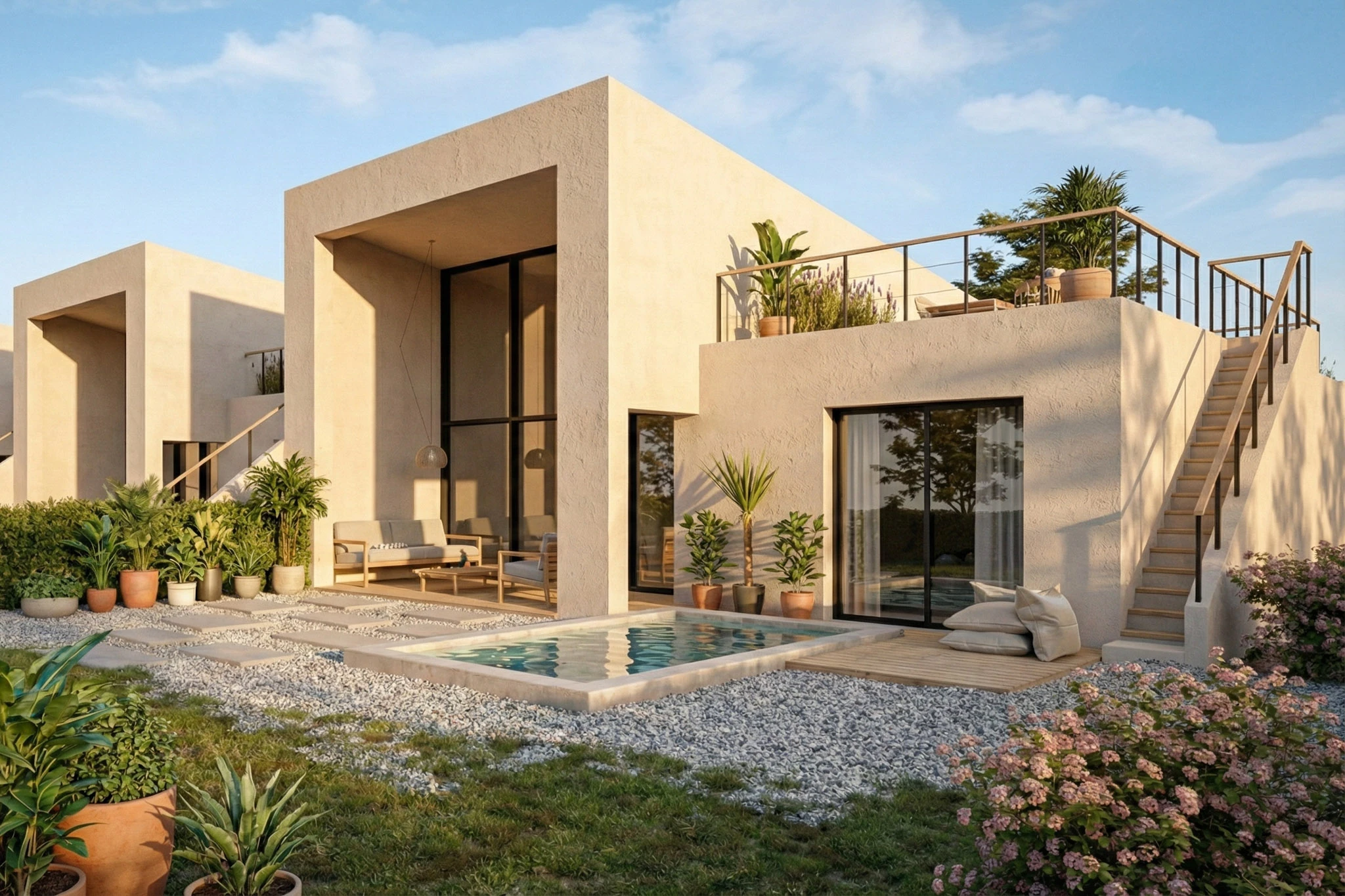
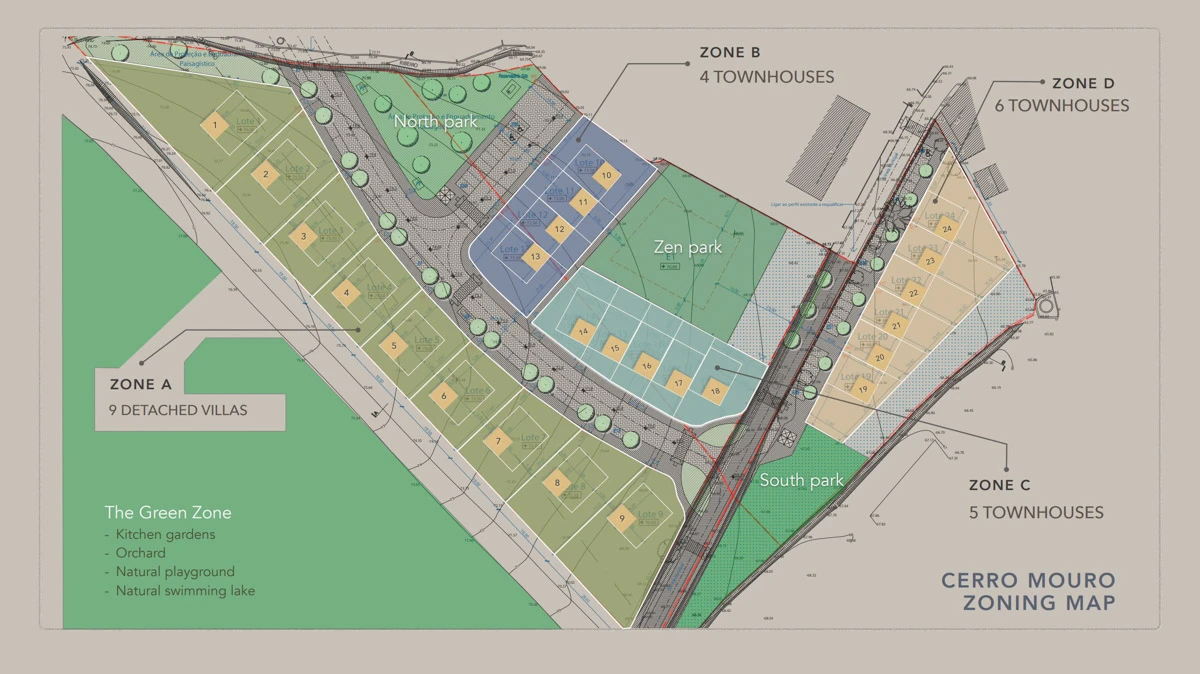
Twenty-four homes across 1.5 hectares. Nine detached T4 villas at 185 m² with private 400-600 m² gardens, and fifteen T2-T3 loft townhouses from 105 to 120 m². Every unit, regardless of size, comes with its own plunge pool, solar panels, heat pump, passive stack ventilation, roof terrace, double glazing, and Passivhaus-class GEALAN window frames as standard.
But the specification sheet is only half the story. What genuinely sets Cerro Mouro apart in the Algarve — and the part I think most buyers underestimate until they walk the site — is the land around the houses.
Beyond the Walls: 1.5 Hectares of Working Landscape
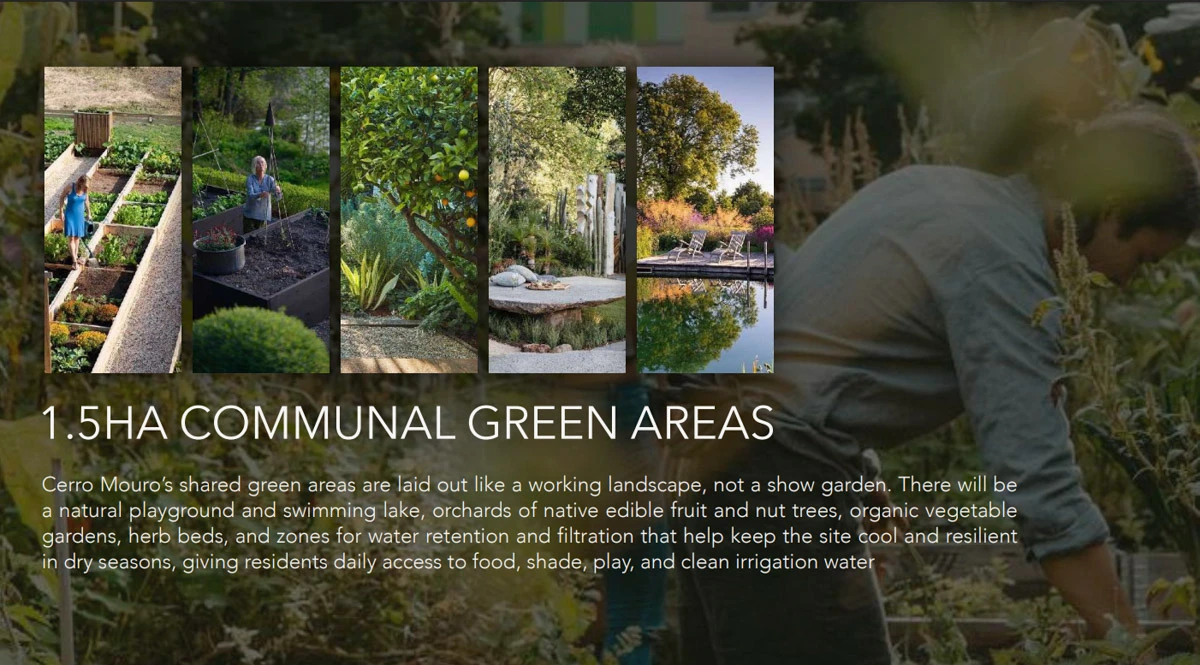
The shared green areas at Cerro Mouro are not ornamental. This is not a clipped lawn with a few palms and a chlorinated pool. It is a working landscape laid out across eight zones, designed so that residents have daily, casual access to food, shade, play, clean water, and quiet.
Here is what that actually means, zone by zone:
- A natural swimming pond, filtered entirely by aquatic plants — no chlorine, no chemicals, no salt
- A seven-layer permaculture food forest – pick fruit, nuts and herbs straight off the land.
- Fruit and nut orchards – a seasonal food supply.
- Communal kitchen gardens and a tunnel greenhouse – for residents who want to grow their own vegetables.
Around those four anchors sit a natural children’s playscape (tree trunks, boulders, a slide integrated into the terrain — no plastic), three themed parks for walking and sitting, and a grey water filtration wetland that recycles the site’s own water to irrigate the orchards and gardens. In a region where water security is an increasing concern, that last one is not a gimmick. The whole site was designed to stay resilient in dry seasons and social without forcing it: places you pass through, places you sit, places you work with your hands, places you can disappear for an hour.
A Community, Not Just a Condominium
Most Algarve developments sell you a house and hand you a set of shared amenities — a pool, a gym, a gate. Cerro Mouro is deliberately built around the idea that twenty-four households sharing orchards, a greenhouse, a chicken coop, a pond and a playscape will actually get to know each other. The scale is right for that: small enough that you recognise your neighbours, large enough that you have privacy when you want it.
The buyer profile reinforces it. Sixty percent of the plots are already sold, and the buyers are overwhelmingly Dutch, German, British and Scandinavian families who are either relocating full-time or splitting their year between Northern Europe and the Algarve. They are, broadly, the people who do want to drop a basket of lemons on a neighbour’s doorstep, who do want their kids playing together in the woods, and who do care whether the swimming water is chlorinated or filtered through iris roots.
That mix — small scale, shared working landscape, aligned values — is genuinely rare in the Algarve. You see it at a handful of eco-projects in Central Portugal, almost nowhere on this coast.
What I Tell Buyers From Northern Europe
If you are coming from the Netherlands, Germany, Austria or Scandinavia, you already know the standard you want — you have lived in it. The question is whether to pay for a retrofit on existing concrete stock, or start with new-build eco-spec.
The pricing is what surprises most of my Northern European buyers. Cerro Mouro townhouses start at €500,000. T4 detached villas start at €755,000. A comparable existing-stock villa at that price almost always needs €60k-€100k of thermal upgrade work to come close on performance — and you are still left with a retrofitted concrete box on a regular plot with a chlorinated pool, not a home built right from the start inside a working landscape with a food forest at the end of the garden.
The new-build passive-spec is essentially priced at the same point as the retrofitted concrete equivalent — without the disruption, without four months in a building site, and with running costs a fraction of what a concrete villa burns through every winter. And the landscape keeps appreciating: every year the orchards and food forest produce more, not less. Handover is scheduled for Q2 2027.
One More Thing
The retrofit maths is specific to each house, and there are a handful of existing Algarve villas where going that route genuinely makes sense. But for most year-round buyers from Northern Europe — especially if a swimming pond and a food forest at the end of the garden sounds like the life you actually want – starting with new BMS construction at Cerro Mouro is the shorter path there.
Full development details on the dedicated page: View the full Cerro Mouro development page →
Or, if you would rather start with a conversation about what fits, Cerro Mouro or otherwise, fill out the buyer enquiry form and I’ll get back to you within a day.