
Selling a property in Portugal in 2026 typically costs 6% to 10% of the sale price. The biggest items are the agency fee plus 23% VAT, then capital gains tax on 50% of your gain at progressive rates. On a €550,000 Lagos sale, that is roughly €48,000.
This guide is built around a common Lagos seller profile: British or Dutch, bought between 2015 and 2019, now non-resident for tax. Below is the full working on a typical sale, the documents you need before you list, and the one mistake that most often throws out a seller’s own maths.
What does it cost to sell a property in Portugal in 2026?
There are four costs that actually move your net proceeds, and one that only matters if something is missing from your paperwork:
- Agency fee: commonly around 5% in the Western Algarve, plus 23% VAT.
- Energy certificate: legally required before the property is advertised, usually a few hundred euros.
- Mortgage cancellation: early repayment fees are capped by law at 0.5% of the amount repaid on a variable rate and 2% on a fixed rate, plus your bank’s own charges.
- Capital gains tax (IRS): 50% of the gain is taxed at progressive rates, for residents and non-residents alike.
- Missing licence of use: no longer needed at the deed, but a buyer’s bank will usually ask for it, so regularising it can cost time and money.
IMI, the annual property tax, is charged to whoever owns the property on 31 December. Splitting it pro rata with the buyer is a matter of agreement in the contract, not something the law does for you.
A worked example: selling a €550,000 apartment in Lagos
Take a Dutch couple who bought a two-bedroom apartment in Lagos in 2017 for €330,000, paid about €20,000 in IMT, stamp duty, notary and registry fees at the time, and spent €25,000 on a new kitchen and bathroom in 2021, with invoices. They are non-resident and mortgage-free, and they sell in 2026 for €550,000.
First, the capital gain. Portugal lets you uplift the purchase price for inflation using an official coefficient, then deduct your costs:
| Capital gain calculation | Amount |
|---|---|
| Sale price | €550,000 |
| Purchase price x 1.18 inflation coefficient (2017) | – €389,400 |
| Purchase costs (IMT, stamp duty, notary, registry) | – €20,000 |
| Invoiced improvements within the last 12 years | – €25,000 |
| Agency fee including VAT | – €33,825 |
| Energy certificate | – €250 |
| Capital gain | €81,525 |
| Taxable share (50%) | €40,763 |
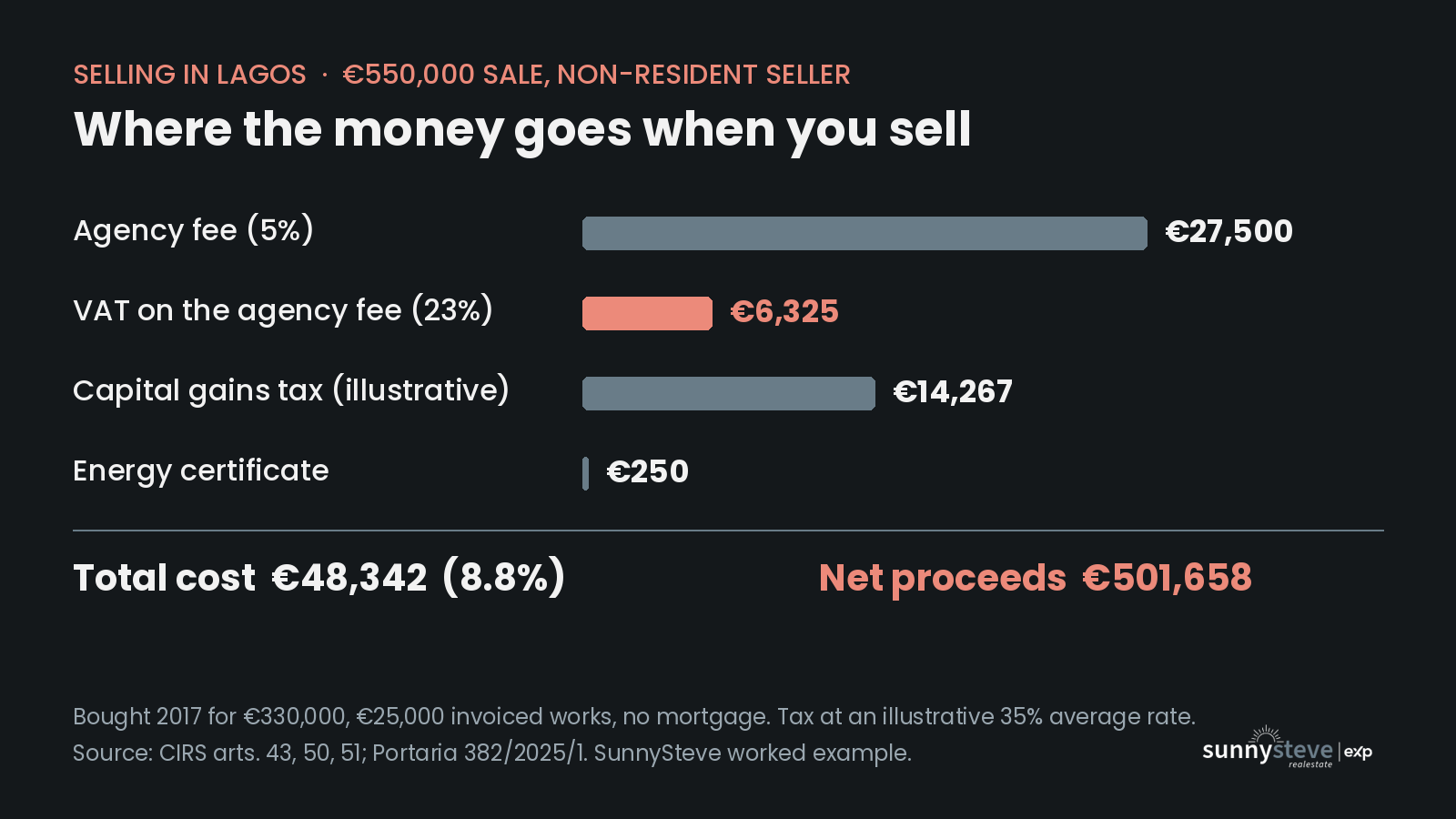
Then the net proceeds. The tax line depends on your total worldwide income, so I have used an illustrative 35% average rate:
| Net proceeds on a €550,000 sale | Amount |
|---|---|
| Sale price | €550,000 |
| Agency fee (5%) | – €27,500 |
| VAT on the agency fee (23%) | – €6,325 |
| Energy certificate | – €250 |
| Mortgage cancellation | €0 (mortgage-free) |
| Capital gains tax (illustrative, 35% of €40,763) | – €14,267 |
| Net proceeds | €501,658 |
Two lessons from that example. The kitchen invoice alone took €12,500 off the taxable share, which is roughly €4,375 of tax at a 35% rate, so keep every invoice in the owner’s name. And your sale price is the number that drives everything else, so get a realistic figure for your own home with the SunnySteve valuation before you start planning around it.
The mistake most sellers make: the agency fee without VAT
Sellers often do their own sums using 5% for the agent. In Portugal the commission is a service, and services carry 23% VAT. On a €550,000 sale that is a €6,325 gap between what people budget and what they pay, more than the energy certificate, the notary and the registry fees put together.
When you compare agencies, compare the fee with VAT included, and check what it covers. A lower headline fee that excludes photography, legal coordination or international marketing is not cheaper if the property sits for nine months.
Capital gains tax: residents and non-residents compared
Until 2022, non-residents paid a flat 28% on the whole gain. Since 1 January 2023 the rules are aligned with residents, as the tax authority confirmed in Ofício-Circulado 20255/2023. My capital gains guide goes deeper; here is the short version as of October 2026:
| Rule | Portuguese tax resident | Non-resident |
|---|---|---|
| Share of the gain taxed | 50% | 50% |
| Rate | Progressive IRS rates | Progressive IRS rates, set using your worldwide income |
| Inflation coefficient (held over 24 months) | Yes | Yes |
| Deductible costs | Purchase costs, agency fee, improvements in last 12 years | Same |
| Relief for reinvesting in a new main home | Yes, if the property sold was your main home | Only if it was your Portuguese main home, which is rare |
| 2026 to 2029 relief for reinvesting in a long-term let in Portugal | Available, strict conditions | Check eligibility with your accountant |
| When it is paid | IRS return April to June 2027 | Same, via a fiscal representative or electronic notification |
The worldwide-income point matters more than people expect. Two non-residents with the same Lagos gain can pay quite different amounts, because a large pension or salary at home pushes the rate up. Run your own numbers with an accountant before you accept an offer, not after.
What you need before you list
Having these ready is what turns an accepted offer into a signed CPCV in weeks rather than months. I cover where this fits in the wider process in my four-phase selling framework.
- Caderneta predial: the tax registration, from the Portal das Finanças.
- Certidão permanente: the land registry certificate, showing ownership and any charges.
- Energy certificate: required before you advertise.
- Licence of use: not needed at the deed since 2024, but most buyers’ banks still want it.
- Ficha técnica da habitação: for homes licensed after 2004, if you have it.
My seller guide walks through each one, including how to fix the common gaps, like an extension that was never registered.
This is general information as of October 2026, not tax advice. Tax depends on your residence, your total income and how the property was acquired, so confirm your figures with a Portuguese accountant.
Frequently Asked Questions
What does it cost to sell a property in Portugal in 2026?
Expect roughly 6% to 10% of the sale price. The agency fee of around 5% carries 23% VAT, so it is really about 6.15%. Add a few hundred euros for the energy certificate, any mortgage cancellation costs, and capital gains tax on 50% of your gain at progressive rates.
Is VAT charged on estate agent fees in Portugal?
Yes. Estate agency commission in Portugal carries VAT at the standard 23% rate. A 5% fee on a €550,000 sale is €27,500 plus €6,325 VAT, so €33,825 in total. Always ask whether a quoted fee includes VAT before you sign the mediation contract.
How much capital gains tax does a non-resident pay when selling in Portugal?
Since 1 January 2023 non-residents are taxed like residents: 50% of the gain is added to income and taxed at the progressive IRS rates, with your worldwide income counted only to set the rate. The old flat 28% on the full gain no longer applies. The gain is reduced by inflation coefficients, purchase costs, the agency fee and invoiced improvements from the last 12 years.
How long does it take to sell a property in Lagos?
Once a buyer agrees a price, the promissory contract (CPCV) is usually signed within two to four weeks and the deed typically follows one to three months later, depending on the buyer’s financing. Getting the paperwork ready before you list is what keeps that timeline short.
Thinking of selling in Lagos and want to know what you would actually walk away with? Start with a free valuation, or tell me about your property and I will work through the net figure with you.