

Last updated: October 2026
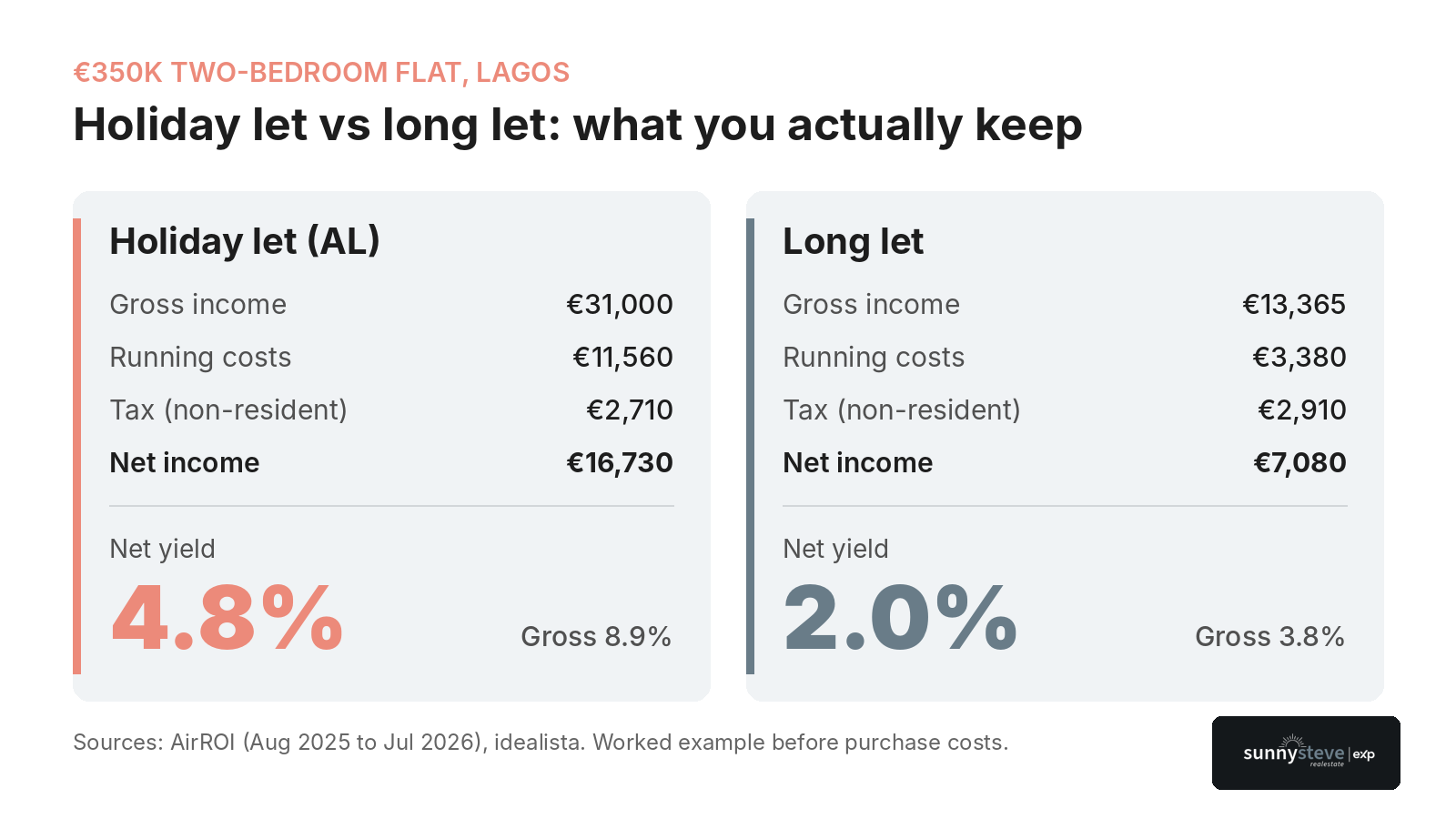
A two-bedroom holiday let in Lagos bought for around €350,000 can gross close to 9% a year. After management, running costs, IMI and tax, a realistic net yield is about 4.8%. The same flat on a long let nets roughly 2%.
Those are the numbers I walk British and Dutch investors through when they tell me they want a place in Lagos that pays for itself. Below is the full working, so you can swap in your own figures.
What rental yield can I expect from a holiday let in Lagos, Portugal in 2026?
Take a typical buy in the €300k to €400k band: a 75 m² two-bedroom flat in Meia Praia or on the edge of the old town, bought for €350,000. At Lagos’s average asking price of €4,729/m² (idealista, September 2026), that is a fair price for the size.
For the holiday-let side I use AirROI’s market data for Lagos, covering August 2025 to July 2026: an average nightly rate of about €184 and average occupancy of 46% across the year, with roughly 3,580 active listings. For the long let I use idealista’s latest Lagos asking rent of €16.20/m² a month. Here is how the two compare for the same flat:
| €350k T2 in Lagos, 75 m² | Holiday let (AL) | Long let |
|---|---|---|
| Occupancy | About 46% across the year: 64% in June to September, 33% from November to January | 11 months let, one month empty between tenants |
| Rate | About €184 a night on average: around €210 in summer, €160 in winter | About €1,215 a month (€16.20/m²) |
| Gross income | €31,000 | €13,365 |
| Management | €6,820 (22% of gross) | €1,340 (10% of rent) |
| Utilities, internet, insurance, linen | €3,000 | €300 (insurance; tenant pays utilities) |
| Condominium fees | €1,200 | €1,200 |
| IMI (0.3% in Lagos) | €540 | €540 |
| Income tax (non-resident) | €2,710 | €2,910 |
| Net income | €16,730 | €7,080 |
| Gross yield / net yield | 8.9% / 4.8% | 3.8% / 2.0% |
A few of those lines need explaining, because they are where most online yield calculators go wrong.
Gross yield vs net yield: where the money goes
- Management is the biggest cost. Unless you live here, you need someone handling check-ins, cleaning, laundry and guest messages. In the Algarve that typically runs at 20 to 25% of gross bookings. I use 22%.
- The owner pays the bills on a holiday let. Electricity, water, internet, insurance and linen are yours. On a long let the tenant pays the utilities.
- IMI is low in Lagos. The council keeps the property tax at 0.3%, the legal minimum, and confirmed it will stay there for 2027. It is charged on the property’s tax value, which is usually well below the price you pay.
- Nothing here includes purchase costs. IMT, stamp duty and notary fees come on top of the €350,000. Run your own numbers with the closing cost calculator.
How holiday-let income is taxed for non-residents
For a non-resident owner, holiday-let income is business income (Category B). Under the simplified regime only 35% of the gross is treated as taxable, and that slice is taxed at 25%. On €31,000 gross that works out at about €2,710, an effective rate under 9% of turnover.
Long-let income is taxed differently: 25% on the rent after deductible costs such as condominium fees and IMI. On a lower income, the bill ends up slightly higher in euros than on the holiday let. The extraordinary AL contribution (CEAL) introduced in 2023 was abolished in 2024, so there is no extra levy on top. Tax rules depend on your own situation, so check with a Portuguese accountant before you commit. This is not tax advice.
Can you still get an AL licence in Lagos in 2026?
Yes, as of early October 2026. Lagos has not created containment areas or published a municipal AL regulation, so new AL registrations for flats and houses are still possible across the municipality. I covered the detail in my Alojamento Local guide.
There is one date to watch. Councils with more than 1,000 AL registrations, which includes Lagos, have until 31 December 2026 to decide whether to regulate, and can suspend new registrations while they do. Existing licences are not affected. If a holiday let is your plan, register as soon as you complete, and check the council’s position again before you sign the promissory contract.
The mistake I see most: using it yourself in August
Most of my investor buyers are not pure investors. They want the flat to pay for itself and they want six weeks of sun in it every summer. That is completely reasonable, but it is expensive. August is Lagos’s best month, with occupancy around 78%.
Block six summer weeks for yourself and you give up roughly €6,900 of bookings. After the management fee and tax you would have saved, net income drops to about €11,960, or 3.4%. Use the flat in May or October instead and you lose far less. If you are still deciding where to buy, my guide to buying property in Lagos as a foreigner covers the process from first viewing to keys.
Holiday let or long let: which should you choose?
Choose the holiday let if you want the higher yield, you are happy to pay a good local manager, and you can live with winter months that barely cover costs. Choose the long let if you want a steady income with almost no hands-on work, or if you are worried about AL rules changing.
One thing worth knowing on the long-let side: Portugal’s rental reform, approved by the government in July 2026, would remove the cap on rent increases between contracts and make it easier to act on arrears. I explained what it means in Portugal’s new rental rules for landlords. It is still before Parliament, so do not price it in yet.
My view: for a T1 or T2 in Lagos at €300k to €400k, a well-run holiday let is still the better investment, and a 4 to 5% net yield is a fair expectation. Anyone promising you 8% net on a flat in town is quoting gross. To estimate your own figures, try the short-term rental simulator, or see what a property you already own is worth with the SunnySteve valuation.
Frequently Asked Questions
What rental yield can I expect from a holiday let in Lagos, Portugal in 2026?
A €350,000 two-bedroom holiday let in Lagos can gross about 8.9% a year, around €31,000. After management, running costs, IMI and non-resident tax, a realistic net yield is about 4.8%. If you use the flat yourself for six summer weeks, expect closer to 3.4%.
What is a good rental yield in Portugal?
For a holiday let in an established Algarve town like Lagos, 4 to 5% net is a good, realistic result. Long lets in Lagos typically net around 2% because rents are low relative to purchase prices. Be wary of any figure above 7% unless it is clearly labelled as gross.
Is Airbnb a good investment in the Algarve?
It can be, if the property is in a strong holiday location and professionally managed. In Lagos, occupancy averages about 46% across the year, from roughly 78% in August to 30% in December, so the summer months carry the whole year. A property that relies on winter bookings will struggle.
How much tax do non-residents pay on holiday rental income in Portugal?
Under the simplified regime, 35% of gross holiday-let income is treated as taxable and taxed at 25%, which works out at under 9% of turnover. Long-let income is taxed at 25% after deductible costs. Always confirm your own position with a Portuguese accountant.
Looking for a flat in Lagos that can earn its keep? Tell me what you are looking for and I will send you options with realistic rental figures, not brochure ones.