
I worked with an English couple a while back who had done everything right. They found a plot in Lagos, fell in love with it, and bought it to build their dream home. Then the licensing started. The back and forth with the camara dragged on far longer than anyone warned them it would. Permit queries, resubmissions, more waiting. By the time the approved project finally landed in their hands, three years had passed.
They were exhausted. Not excited to break ground, exhausted. And when they did the maths on the build itself, another two to three years of construction ahead of them, they made a decision I completely understood: they sold the plot with the approved project attached and walked away. They never laid a single brick.
That story used to be the rule, not the exception. Two things have changed it this year. The first is the new Simplex, which has overhauled how building permits work in Portugal. The second is a way of building that is standard across northern Europe and North America but still rare here: CLT, cross-laminated timber. Put the two together and the timeline I quote clients now is roughly one year from plot to finished home, not three.
How long does it take to build a house in the Algarve?
The honest answer until recently was three to five years if you were starting from a bare plot. Most of that was not construction. It was permitting. The traditional route meant a full building licence from the camara, with no hard deadline on the council to actually decide, which is how my English couple lost three years before a single wall went up.
The Simplex urbanistico reform, brought in under Decree-Law 10/2024, changed the structure. Traditional building licences have been replaced in many cases by a prior notification, and where a licence is still needed the council now faces firm deadlines. If they do not decide inside 120 days for a home of 300 square metres or less, approval is granted tacitly. The clock is finally on your side rather than the council’s. That alone can take a year or more out of the front end of a project.
The build itself is where CLT does the heavy lifting. The structure is engineered and cut in a factory, then delivered and assembled on site like a precision kit. A timber shell that would take many months in blockwork goes up in weeks. Combine the faster approval with the faster build and one year stops being a sales pitch and starts being a realistic plan.
Why CLT beats concrete for an Algarve build
CLT is not a budget shortcut or a cabin in the woods. It is solid, cross-layered structural timber, the same material used to build apartment blocks, schools and offices across Austria, Germany and Scandinavia. What makes it interesting for a buyer here is that the speed comes without giving up quality. You get a high-specification, high-luxury finish on a controlled, predictable cost, because so much of the structure is priced and built in a factory rather than discovered on a chaotic site.
The two years you save are not just lifestyle months. They are holding costs, financing, inflation on materials, and rent or a second home you are paying for while you wait. Time is the most expensive line item in any build, and CLT attacks it directly. On top of that, Portugal’s new 6% VAT rate on new-build construction can cut a real chunk off the build cost itself, if the finished home will be your primary residence and stays under the value cap.
| Factor | Traditional concrete build | CLT timber build |
|---|---|---|
| Plot to finished home | Typically 3 to 5 years | Around 1 year with the new Simplex |
| Structure on site | Months of blockwork and curing | Factory-cut, assembled in weeks |
| Cost certainty | Prone to overruns and delays | Largely fixed and priced upfront |
| Energy performance | Varies, often needs heavy cooling | A+ achievable, holds temperature naturally |
| Humidity and mould | Concrete plus Algarve damp is a known problem | Breathable build-up, insulated, no mould risk when detailed correctly |
| Sustainability | High embodied carbon | Renewable timber from managed forests |
Does timber really hold up to the Algarve climate?
This is the first thing every buyer asks me, and it is a fair question. Our coast is humid, and concrete homes here are no strangers to damp and mould. The key with CLT is the build-up around the timber, not the timber alone. Done properly, with stone wool insulation through floors, ceilings and roof, a breathable wall construction and good ventilation, a CLT house manages moisture better than the concrete villa next door, not worse.
The walls breathe and regulate humidity rather than trapping it. They also hold the day’s temperature, so the house stays comfortable through an Algarve summer without the air conditioning grinding away. Lower bills, quieter rooms, healthier air. This is exactly why it has become standard in climates far harsher than ours.
See it standing before you commit: the Praia da Luz villa
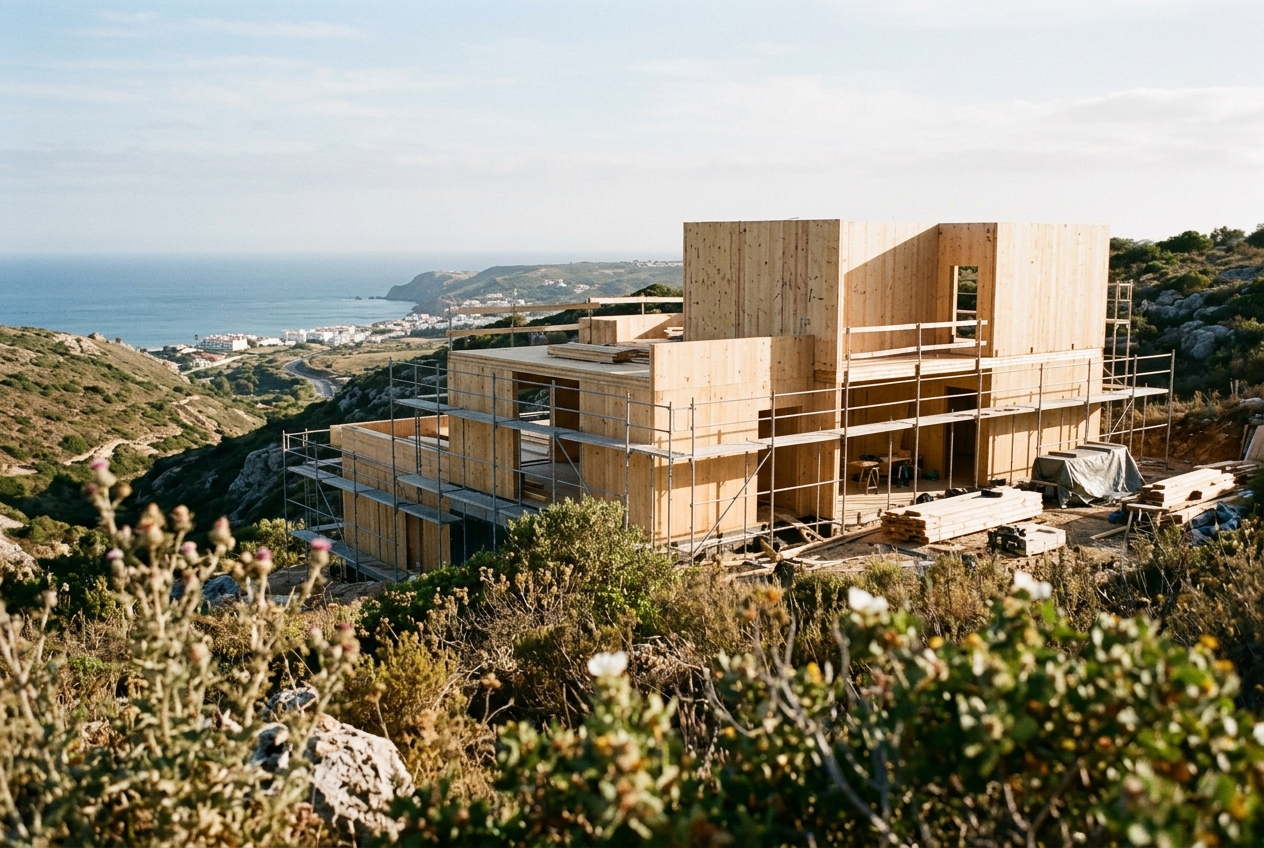
If you would rather skip the build entirely and buy the result, I have one you can look at right now. It is one of the only CLT homes going up in the Western Algarve: a four-bedroom, A+ energy villa with a heated pool on a 717 square metre southwest-facing plot in Praia da Luz. The MM Crosslam timber structure is already standing, Rockwool insulation throughout, Panasonic heat pump, triple-glazed timber-aluminium windows, and it is roughly six months from completion.
It is the clearest proof I can offer of what we are talking about. You can walk the structure while the timber is still exposed, see exactly how the house is built, and watch it finish. For anyone who has never lived in a timber-frame home, standing inside one before the walls close up is worth the trip on its own.
Frequently Asked Questions
Is CLT construction more expensive than concrete in the Algarve?
The headline structural cost is broadly comparable, and on the total project CLT often wins because you save two years of holding costs, financing and delay. Because so much is built and priced in a factory, the budget is far more predictable than a traditional site where overruns are common.
Does timber construction cope with the humidity on the Algarve coast?
Yes, when it is detailed correctly. The performance comes from the whole build-up: stone wool insulation, a breathable wall, good ventilation and proper moisture barriers. Built that way, a CLT home regulates humidity better than the typical concrete villa, which is why it is standard across northern Europe.
What is the Simplex and how does it speed up building permits in Portugal?
The Simplex urbanistico, under Decree-Law 10/2024, simplified the permitting regime. It replaced many full building licences with a prior notification and imposed firm decision deadlines on councils, with tacit approval if they miss them. In practice it removes much of the open-ended waiting that used to stall builds for years.
Can I buy a CLT villa in the Algarve that is already being built?
Yes. I currently have a four-bedroom CLT villa in Praia da Luz with the structure already standing and completion around six months out. It is a rare chance to buy a brand-new timber home in the Western Algarve without waiting on a permit queue or starting from a bare plot.
Is a CLT house as durable as a concrete one?
Yes. Cross-laminated timber is a certified structural material used for multi-storey buildings across Europe and North America. Properly designed and maintained, a CLT home matches concrete on durability and lifespan while outperforming it on energy use and indoor comfort.
Build your own in a year, or buy one already going up
Whether you want to build your own CLT villa from scratch in roughly a year or step into a CLT home that is already standing, the route through is much shorter than it was even twelve months ago. Tell me what you have in mind and I will walk you through the plot, the permitting and the build timeline honestly. Tell me what you are looking for on the Buyer form and let’s map out what one year actually looks like for you.